Table of Contents
| Title: | Kirstie Rea |
|---|---|
| Duration: | 02:26 |
| Year: | 2025 |
| Production: | Handmade Films (Australia) |
| Production Crew: | David Silva, Alex Ballingall, Ben Chew, Luca Rabak |
Kirstie Rea, an esteemed Australian glass artist based in Canberra, has significantly contributed to the contemporary glass art scene over the past three decades. Establishing her studio in 1987, Rea has developed a distinctive practice that explores the intricate relationship between humans and the natural environment. Her work is celebrated both nationally and internationally, with pieces housed in prestigious institutions such as the Victoria and Albert Museum in London and the National Gallery of Australia.
Rea’s artistic journey is deeply rooted in her connection to the Australian landscape. Born and raised in Canberra, she draws inspiration from the region’s diverse terrains, translating her experiences into glass forms that evoke the essence of place and memory. Her creations often reflect the subtle nuances of the environment, capturing the interplay of light, color, and texture.
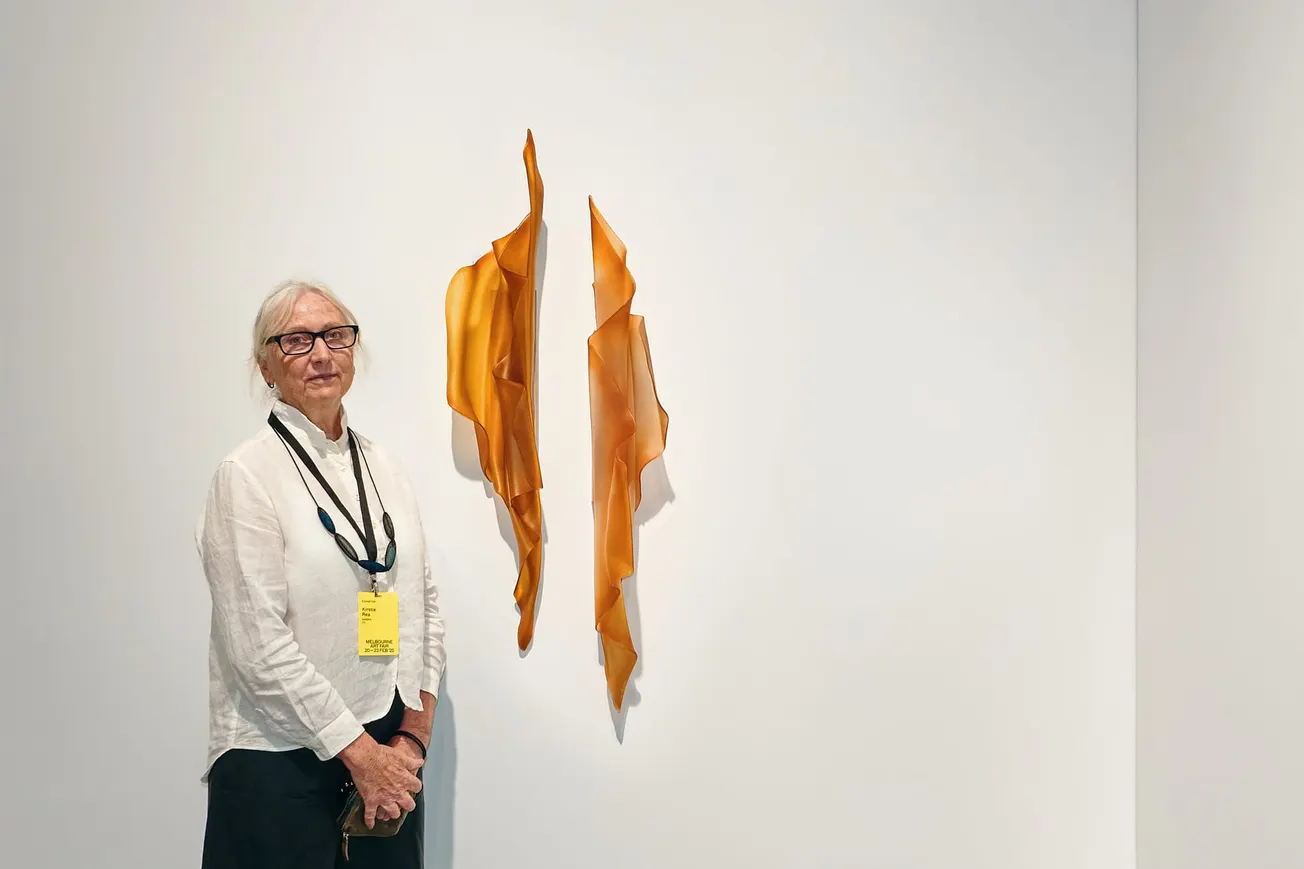
At the Melbourne Art Fair 2025, held from February 20 to 23 at the Melbourne Convention & Exhibition Centre, Rea presented her latest exhibition, “In the Company of Nature,” through Sabbia Gallery. This collection showcased Rea’s continued exploration of the natural world, featuring works that embody her signature approach to glass artistry. One notable piece from the exhibition, “Of gesture and nature 2” (2025), is a folded glass wall panel measuring 99.5 x 70.5 x 17.5 cm. This work exemplifies her ability to manipulate glass into forms that convey fluidity and movement, reminiscent of natural elements.
Rea’s technique involves the innovative use of kiln-formed glass, where she harnesses heat and gravity to shape sheets of glass into sculptural forms. This process allows her to create pieces that appear both delicate and dynamic, capturing the ephemeral qualities of the landscapes that inspire her. Her works often feature folds and undulations, suggesting the contours of hills, valleys, and waterways.
Beyond her studio practice, Rea has played a pivotal role in glass education and mentorship. She has taught at esteemed institutions such as the Australian National University Glass Workshop and internationally at venues including Pilchuck Glass School in the USA and North Lands Creative Glass in Scotland. Her dedication to teaching has influenced a generation of glass artists, furthering the development of the medium globally.
Rea’s contributions have been recognized with numerous accolades, including the Ausglass Honorary Life Membership Award in 2009 for her impact on glass education in Australia. Her work continues to resonate with audiences, offering a contemplative experience that bridges art, nature, and personal reflection.
In “In the Company of Nature,” Rea invites viewers to immerse themselves in her interpretation of the natural world, encouraging a deeper appreciation for the landscapes that shape our experiences and identities. Through her mastery of glass, she captures the essence of nature’s forms and rhythms, creating works that serve as both visual poetry and meditative objects.