Table of Contents
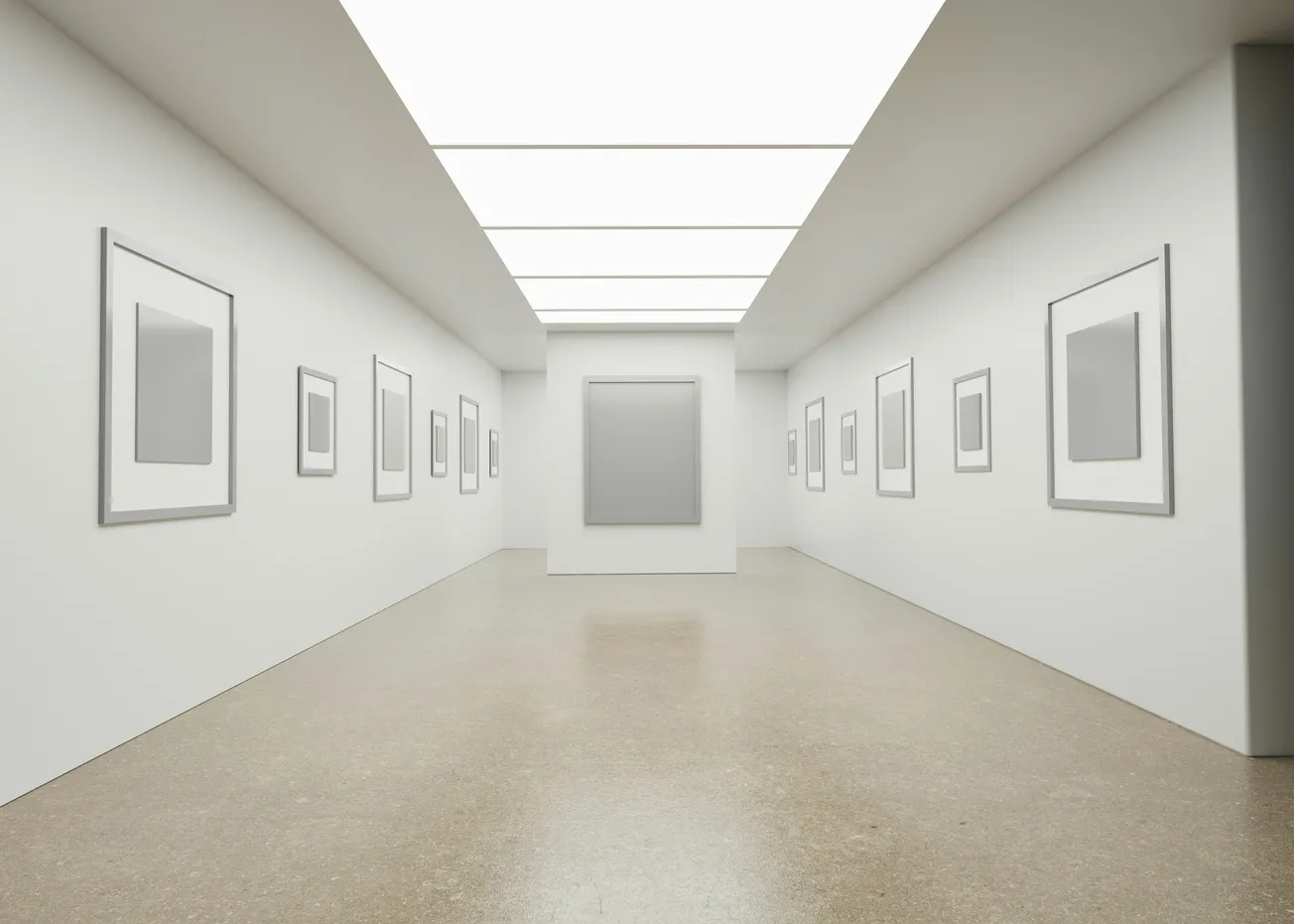
You've been in this gallery before. Maybe not this specific one, but this one, the cube. White walls. Polished concrete or timber floors. Track lighting that casts dramatic shadows on carefully arranged white space. The air feels cooler somehow, more controlled. Your voice drops without you meaning it to. You move slowly. You stand in front of each work for what feels like the “right” amount of time, not too quick (you'd seem unappreciative), not too long (you'd seem pretentious).
Everyone around you is doing the same quiet choreography; a conveyor belt of pause, gaze, consider, move on.
This is the white cube, and it has become so universal that I think we've stopped noticing it's even a choice. It feels inevitable. Timeless. The natural way to display art. But here's the thing nobody tells you: every element of that space, from the colour of the walls to the height of the ceiling to the quality of silence, is deliberate psychology designed to make you feel a specific way.
And crucially, it's designed to make certain kinds of people feel like they belong, while making others feel like they've wandered into someone else's wedding (or a funeral).
How We Got Here: The Mythology of the Neutral Space
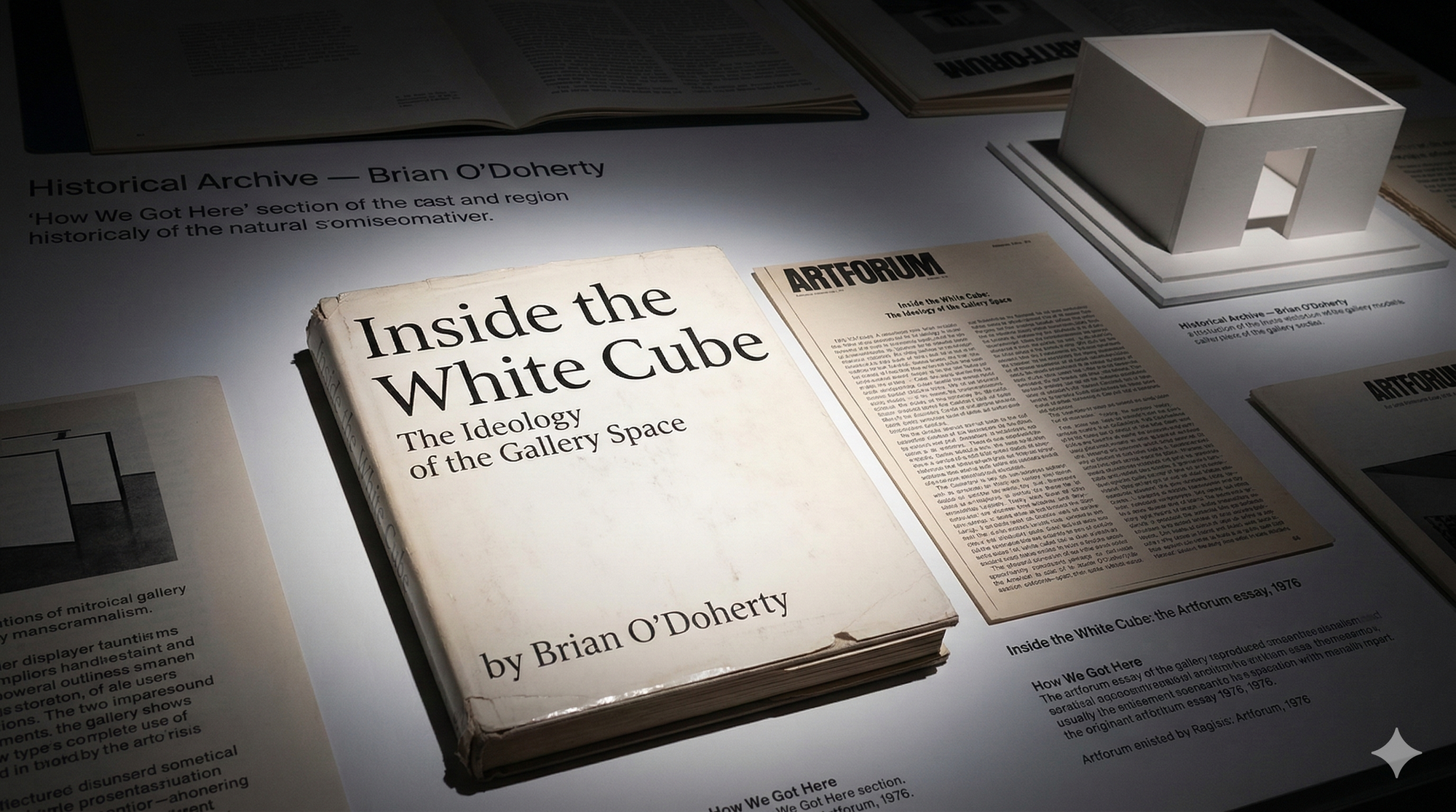
In 1976, a critical essay appeared in Artforum that would change how we think about gallery spaces forever. Its author was Brian O'Doherty, an Irish-American artist and writer who understood something fundamental: spaces aren't neutral. They're arguments.
O'Doherty's essay, which was later collected into the influential book Inside the White Cube, deconstructed the mythology of the “neutral container.” He described the white cube as a space where “Esthetics are turned into commerce” and where the gallery's exclusivity is built into its very architecture. The whiteness isn't cleanliness. It's a statement. The emptiness isn't absence. It's a choice. The silence isn't respect. It's control.
What O'Doherty identified was something that designers of influence have understood for centuries: a space is never just a space. It tells you how to behave. It tells you who it was made for. It trains your body and your mind.
The white cube, he argued, creates a “religious atmosphere.” You understand this intuitively when you're inside one. Your behaviour changes. Your voice changes. Your pace changes. You move with reverence, with care. Why? Not because the art demands it, but because the space itself has been engineered to produce that response. It's Pavlovian. You enter the white cube and your body automatically knows to be quiet.
This is extraordinarily powerful. But it's not neutral. It's a specific kind of attention, designed for a specific kind of viewer, that makes a specific kind of art visible while rendering other kinds invisible.
The Tyranny of the Uniform: Why Every Gallery Looks the Same
Travel the world, and you'll notice something remarkable: a contemporary art gallery in Sydney looks almost identical to one in Berlin, Singapore, or Los Angeles. Same white walls. Same lighting rigs. Same polished floors. Same sense that you've entered a space fundamentally separate from ordinary life. Same conveyor belt.
This isn't accidental. It's not that architects all independently decided white walls are best. It's that the white cube has become the international language of contemporary art. To be legible as a serious gallery, you must speak this language.
Think about it from the perspective of a collector or dealer. If every gallery looks the same, then works become comparable. You can photograph a work in one white cube and display its image in another white cube on the other side of the world, and it will look almost identical. The frame drops away. Only the commodity remains. The white cube is, in effect, an invisible container, which means what matters is what's inside it: the art. The price. The provenance. The investment potential.
This is brilliant marketing. It's brilliant capitalism. It's terrible for access and plurality.
And here's where it gets particularly insidious: even artist-run spaces. Spaces that explicitly positioned themselves as alternatives to the commercial gallery system have adopted the white cube formula. Why would a radical space doing anti-capitalist work replicate the exact aesthetic of the capitalist gallery system?
Because to be taken seriously, to be eligible for grants and institutional recognition, to be “legible” to museums and funding bodies, you have to look like a gallery. You have to play the game. You have to speak the language, even if you're trying to subvert it. This is how systems maintain themselves: by making the alternative look impossible, unprofessional, not real art.
The Statistics: Who Actually Gets In?
Here's where the white cube's exclusivity becomes quantifiable:
Only 24% of Australian adults visit an art gallery in any given year. When researchers look at who comprises that 24%, the picture narrows dramatically. Gallery visitors are disproportionately white, university-educated, and affluent. They're more likely to have been exposed to art as children. They're more likely to have parents who taught them the language of the white cube - the reverence, the contemplation, the unspoken codes of behaviour.
And it's getting worse, not better.
Nineteen years of ABS data show a clear generational divide. Nearly 40% of people aged 40-44 visit galleries annually. That drops to 34% for those aged 16-19. The youngest Australians are not just avoiding commercial galleries - they're avoiding them at accelerating rates. They're saying, quite clearly: this space is not for me.
Is that because they don't care about art? Unlikely. Artists aged 16–19 are thriving, they're just not in white cubes. They're on TikTok, on Instagram, in street art, in video games, in fashion, in music videos. They're making and experiencing visual culture at unprecedented rates. They're just not doing it in the spaces called “galleries.”
What the statistics reveal is that the white cube isn't failing young people because it isn't elegant enough or isn't contemporary enough. It's failing because it requires a specific kind of cultural training, a specific kind of confidence, a specific kind of body that knows how to be in that space.
The white cube wasn't designed for everyone. It was designed for a very specific person: educated, affluent, trained in the rituals of high culture. And when that person walks in, it's a perfect fit. For everyone else, there's a constant sense of not quite belonging, of not quite understanding the unspoken rules, of being an imposter in someone else's space.
The Conspiracy That Isn't Really a Conspiracy
This is where we need to talk frankly about power and money, because the white cube's uniformity isn't actually a mystery. It's a strategy, openly pursued by the institutions that benefit from it.
When every gallery follows the same formula, artworks become transparent commodities. They can be priced, compared, invested in, and flipped. A painting in a white cube in Sydney is immediately comparable to a painting in a white cube in New York. The space becomes neutral (or appears to), and value becomes the only variable. This is extraordinarily valuable for collectors, dealers, and auction houses.
Some of the most influential voices in the art world have admitted as much. Charles Saatchi, one of the world's most important contemporary art collectors, has called the white cube “antiseptic” and “a time warp dictated by museum fashion.” He's not being poetic — he's being strategic. Saatchi shaped contemporary art collecting for decades. He understood exactly how the white cube works, and he's willing to say it's broken.
Jerry Saltz, probably America's most widely-read art critic, has been more direct: “Throw out all the architects who design gigantic impersonal white spaces for art.” He's arguing that the white cube isn't serving art - it's constraining art, limiting what kinds of practice can be seen as “serious.”
Even insider critics see the problem. But the system persists because it's profitable. Because it's standardised. Because it works.
A Fair Defence: What the White Cube Does Well
Here's where intellectual honesty matters. The white cube has defenders, and they're not wrong. Art in a white cube can justify higher prices than the same art on a cafe wall.
The argument is straightforward: by removing distraction, by creating a neutral container, you allow the work itself to speak. Some artists absolutely prefer the white cube. Some works need it. The silence, the emptiness, the sense of reverence - these aren't oppressive for everyone. For people trained in this language, they can be genuinely powerful. They can create space for contemplation that's almost impossible to achieve in a messy, loud, ordinary environment.
There are also practical benefits. White walls don't compete with artwork. Track lighting can be adjusted. The space is functional. It works.
But - and this is crucial - none of this means the white cube is neutral. It means the white cube works really well for a specific purpose and a specific audience. But that specificity doesn't make it universal. It makes it selective. And when it becomes the only visible option, selectivity becomes exclusion.
The Cracks in the System: Alternatives Are Arriving
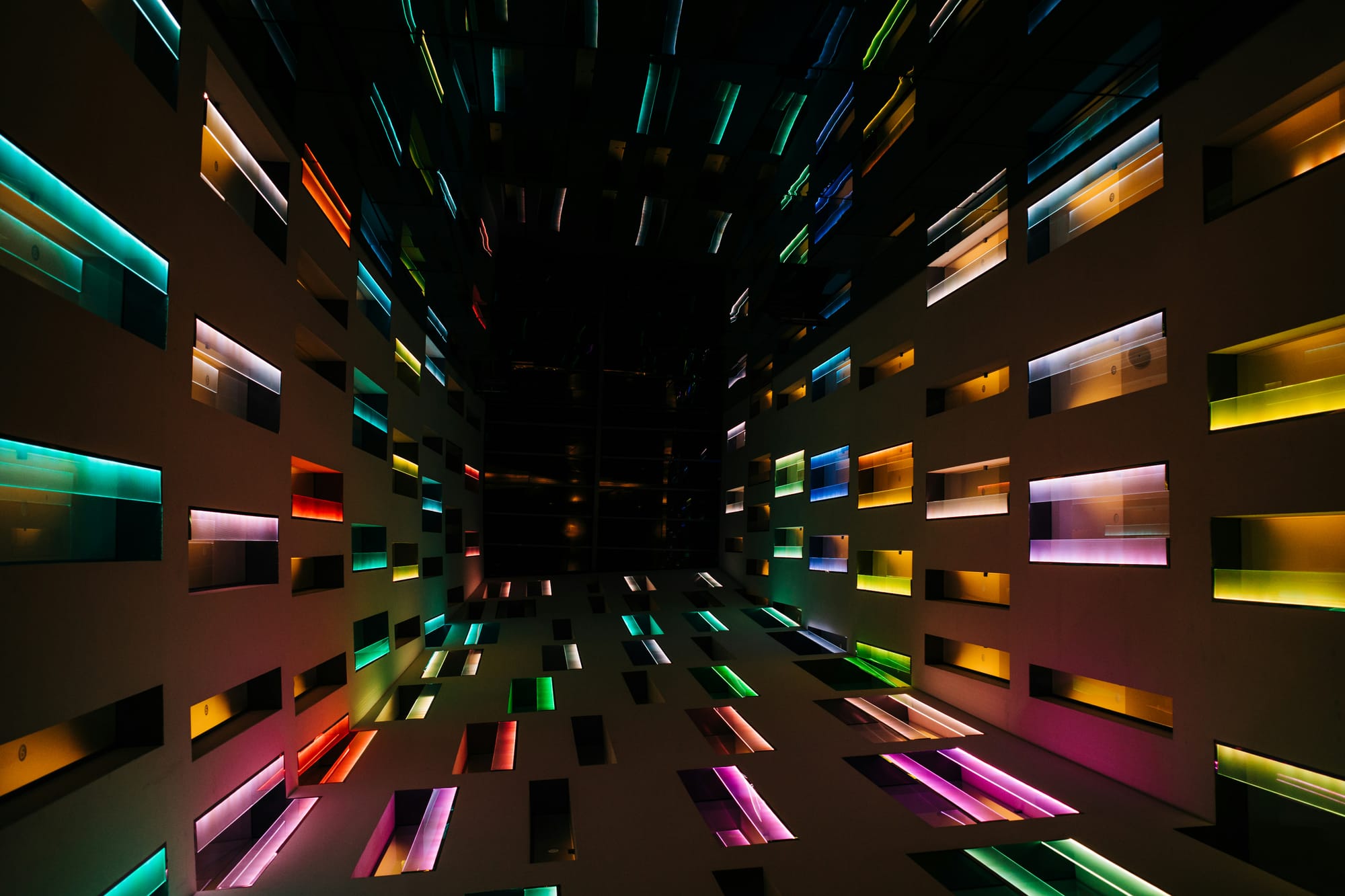
The exciting thing is that the white cube's monopoly is cracking. Meow Wolf, the immersive art collective, creates environments where the rules are different. You don't walk quietly through a Meow Wolf installation - you play. You touch things. You get lost. You have conversations at normal volume. The work isn't separate from the space. You're not contemplating it from a respectful distance. You're inside it. You're part of it. This isn't worse than the white cube. It's different. It makes visible kinds of art and kinds of participation that the white cube renders invisible.
TeamLab, the Japanese art collective, builds participatory digital worlds where the boundary between viewer and artwork dissolves. You're not standing still in front of a painting. You're moving through space. The art responds to your presence. You're not a passive observer -you're an agent in the work. Again, not better or worse than the white cube, but radically different. It prioritises participation and interaction over contemplation and distance.
In Australia, artist-run spaces like Firstdraft, West Space, and COMA Gallery are experimenting deliberately with alternatives. They're messier. They're louder. They're more provisional. They invite conversation rather than silence. They show work by living artists who are questioning the white cube rather than replicating it. They're not perfect alternatives, but they prove that there are options.
These spaces aren't replacing the white cube. They're pluralising it. They're saying: there's no single way to experience art. There's no single kind of space where real art happens.
Where Does This Leave Us?
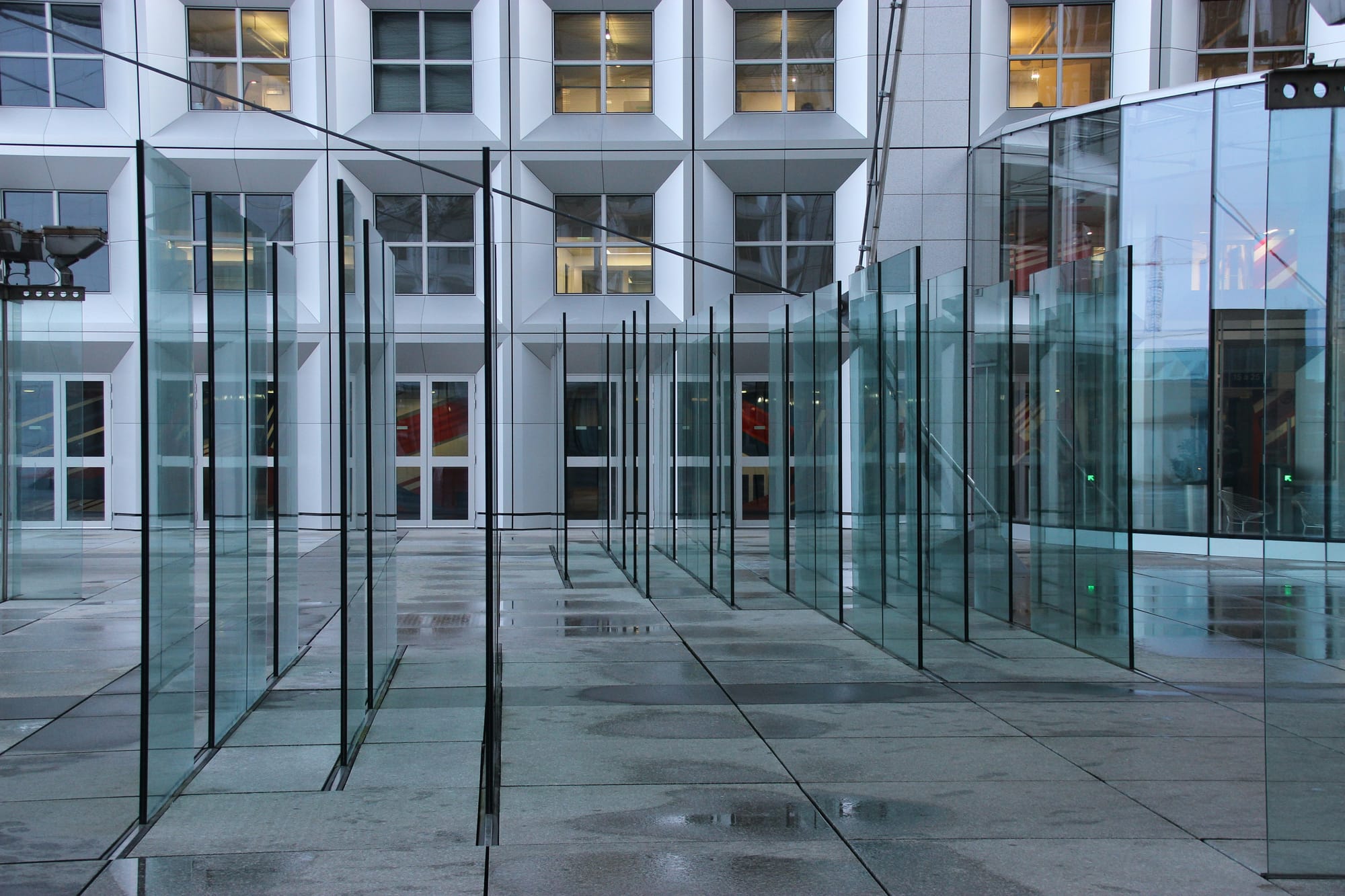
The white cube isn't going anywhere. Collectors love it. Institutions love it. It functions beautifully as a system for making art legible, comparable, and tradeable. Some artists will always prefer it. Some viewers will always feel more comfortable in it.
But here's what matters: it should not be the only option. It should not be invisible. It should not be presented as inevitable, natural, or neutral.
Because when the white cube becomes universal - when it's the only visible gallery space, the only “serious” way to experience contemporary art, the only space that institutions recognise as legitimate - it's not serving art. It's constraining art. It's rendering invisible all the kinds of artistic practice that don't fit neatly into its aesthetic and its codes. It's making certain people feel like they belong in the art world, while making others feel like they've wandered in by mistake.
The real shift would be this: instead of asking how to improve the white cube, we should ask what kinds of spaces, rituals, and experiences we need to make visual culture accessible to everyone - not just the affluent, educated people who were already trained to understand it.
That might mean more immersive environments. More participatory works. More artist-run spaces that break the formula. More galleries in community centres, shopping malls, and parks, not just wealthy precincts. More colours on the walls. More noise. More life.
It means recognising that the white cube made sense for a specific historical moment, a specific kind of art, and a specific kind of person. But that moment doesn't have to be infinite. That kind of art isn't the only art. That person isn't the only person.
Here's a good final question: When you think about entering a gallery space, do you feel like it was designed for you? Or do you feel like you’d have to become someone else? Quieter, more educated, more reverent to deserve to be there? And more importantly: what would it take to change that feeling? A new me, or a new you?