Table of Contents
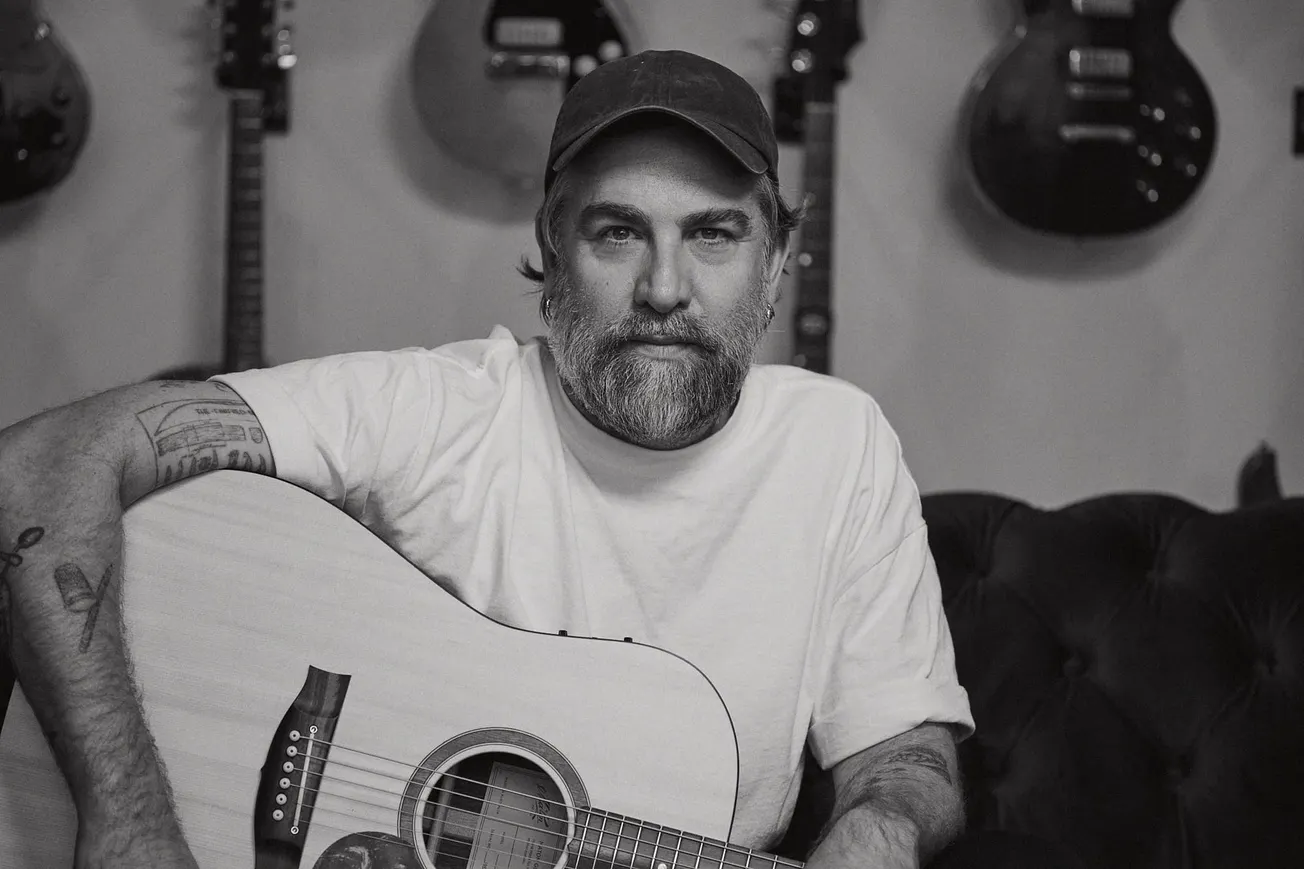
We met in the Melbourne showroom of Australia's celebrated family-owned Maton Guitars. Halfway through the conversation, Josh Pyke breaks off mid-sentence and turns toward the door. "Hey, can you guys keep it down a bit out there?" A small voice answers from somewhere. "You can you hear us?" He laughs. "Very, very loudly."
He swings back to the chair and picks up where he left off, talking about how songwriting and writing children's picture books feed each other. The Pyke house is a working studio, a publisher's office, and a place where small humans are presumably constructing something out of pillows. He has been a solo artist for twenty-two years. The word he'll cop to these days is advocate.
The interview catches him at the tail end of his Feeding the Wolves and Other Stories tour, thirty-six shows around regional Australia commemorating the twentieth anniversary of the mini album he released in November 2005. The set is stripped back. Guitar, vocal, loop pedal, stomp box, and the stories around songs like "Middle of the Hill," "Private Education" and "Gold Mines." What surprised him about the shows was who was in the room.
After the show, he goes out to meet people. The faces keep telling him the same story. "These kids that were five or six when they first heard my music through their parents or older siblings are now adults bringing their own kids to the shows," he says. "Sometimes it's grandparents bringing their grandkids. So this is something new. It feels like a watershed moment."
He thinks the kids in the room are searching for something. "Since 2016 there's been this huge surge of trends and memes on social media. But people are starting to search for more authenticity in their music."
This is not nostalgia talking. This is a guy who began releasing punk EPs in 1995, putting ads in Drum Media and street press that no longer exists, hustling for plays on radio that no longer exists either. He has watched it all evolve through MySpace, Facebook, Instagram, TikTok, the rise of streaming, the slow grinding down of the artist's share. None of it has changed the part of the job he cares about.
"The thing that has not changed is the connection between the artist and the audience," he says. "That is the thing to cultivate and that is the thing to protect at all costs."
He grew up in Balmain, the son of parents with a serious record collection. He was a reader first, prone to disappearing into liner notes. The Doobie Brothers. James Taylor. Jackson Browne. A whole continent of yacht rock and Californian folk that imprinted on him before he had any vocabulary for it. He could sing. At twelve, a friend asked him to join a primary school rock band. He picked up the guitar at fifteen, and that was that. "It started early and it's the only thing that's ever stuck."
The James Taylor records found their way back around. In April 2024, Pyke supported Taylor on his last Australian tour, three A Day on the Green shows with Steve Gadd on drums. "It was an absolute masterclass," he says. "James would come and chat to us every night and hang out after the show. They had a fire set up in these wineries every night."
Pyke is now the kind of musician other musicians lean on. He has been an APRA Ambassador for fifteen years and is the chair of PPCA, the first artist to hold that role. He talks about advocacy the way some people talk about exercise, like it isn't optional. "A lot of musicians don't fully clock what's going on in the industry. There are lots of issues that come up that they need people advocating for them."
His most public piece of cultural work is Busking for Change, a fundraiser he developed with the Indigenous Literacy Foundation, where he has been a Lifetime Ambassador since 2009. Each year, primary schools across the country learn a song written in English and a First Nations language, then busk it on Indigenous Literacy Day. The pilot in 2022 ran in five schools. By 2024, more than a hundred schools were involved. The 2025 song, "Country Tells Us When", was written with Justine Clarke and DOBBY in the Yawuru language of Broome.
There are also the books. Since 2017 he has written more than a dozen children's picture books and shifted over two hundred thousand copies. He doesn't illustrate, doesn't pretend otherwise. He works with different artists each time but keeps returning to Stephen Michael King, with whom he has made Your Head's Not the Place to Store Problems and Some Days You'll Have Days Like These. "You kind of feel like you're fighting the good fight in that kids' space."
The two crafts feed each other. "Writing songs has been almost like a training ground for writing kids' books," he says. "You're trying to tell a story in the least direct way possible, with metaphor and imagery, so that it becomes more universal."
In June he releases his eighth studio album, Kingdom Within, on ADA Music. He recorded it in Byron with Chris Collins, the ARIA winning producer behind records by Matt Corby and Royel Otis. They first met when Collins was nineteen and working as Pyke's guitar tech. He is now one of the most in demand producers in the country. There is a tidiness to that arc Pyke seems to enjoy. "I think it's my best work. Having someone that knew my material intimately, but was taking it forward into the next sonic palette." He wrote it as a body of work, twelve tracks meant to be heard one through twelve, even as the singles peel off in the shape modern releases demand.
Then there is the boat. In October 2008, for the video clip for "Make You Happy" off his second album Chimney's Afire, Maton built him a headstock and logo accurate replica of his Maton CW80E acoustic guitar in the form of a nine horsepower motorboat. It was christened the SS Maton. He sailed it around Rozelle Bay for the cameras, then put it up for silent auction in 2009. It went for seven thousand dollars, and the proceeds seeded what would become Busking for Change. The buyer stayed anonymous. The boat then disappeared.
It has lived a full life since. A few years on someone's lawn in Frankston. A turn or two in some kind of novelty boat regatta in regional Victoria. Then a Facebook Marketplace listing his manager forwarded a couple of weeks ago. Sold again before he even got a chance to look. It has memed its way to Chinese social media, Pyke on his guitar boat, captioned in a language he doesn't read.
"As a boat, it wasn't a great boat," he says. "It was a good looking boat. But damn, it looked good."
He should make a documentary about it, he says. Track the thing down. See where it ends up next.
Twenty-two years in, with a regional tour winding down, an album about reconnecting with your moral core about to land, a school-age army of kids learning songs in Yawuru, a pile of picture books with his name on the spine and a guitar shaped boat out there somewhere doing god knows what, the through-line is the same as the day he was twelve and joined a band because a friend asked. Stay in the room. Write the next thing. Show up for the audience.
"It's the most beautiful part of being an artist," he says. "That connection with you and the audience. I've seen it evolve a lot, but that's one thing that hasn't changed and feels more important than ever."