Table of Contents
There is an irony to Yayoi Kusama becoming one of the most photographed artists in the world. Long before the queues, mirrored selfies, and giant pumpkins, she was making work about the disappearance of the self.
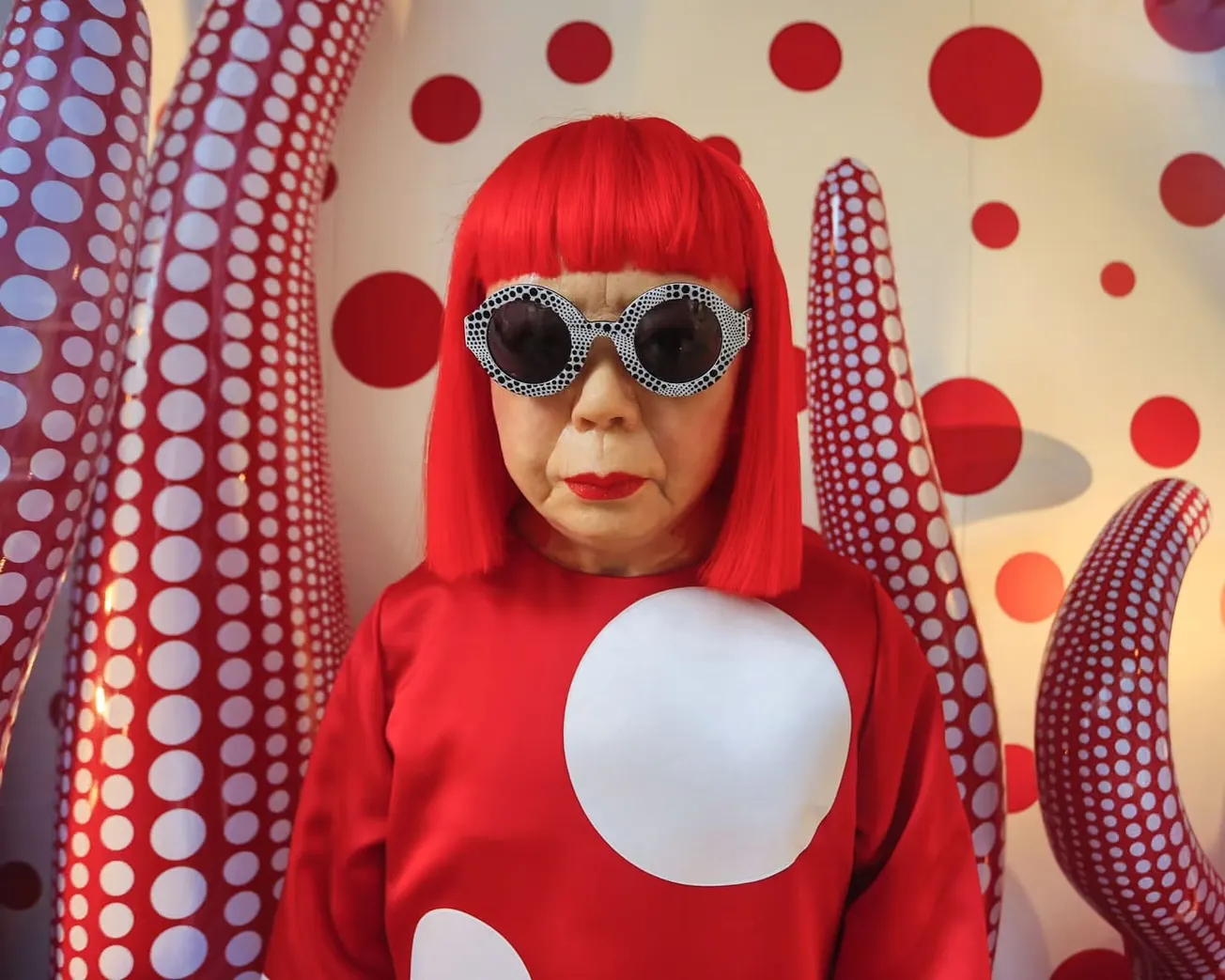
Kusama died on August 14, 2026, at the age of 97, leaving behind a visual language that has become almost impossible to mistake for anyone else's. Polka dots have covered gallery walls, pumpkins, trees, bodies, and fashion collections. Her Infinity Rooms have become cultural events in their own right. When NGV stages Australia's largest Kusama retrospective across the summer of 2024-25, 570,537 people came through the doors, making it the most visited ticketed exhibition in the gallery's history.
Fame on that scale has created a strange problem around her legacy. Kusama's work can now be recognised before it is understood. Put black dots on a yellow pumpkin and the association is immediate. Enter an Infinity Room and taking a photograph has become almost part of the experience. The spectacle is real, and Kusama knowingly embraced it, but the dots, mirrors, and repetition were never simply branding. The grew from ideas she had been working through long before they became fixtures of pop-culture.
When the pattern takes over
Kusama began experiencing hallucinations as a child in Matsumoto, Japan. She recalled flowers speaking to her and patterns multiplying across her surroundings until they seemed to engulf the room and her own body. Drawing and painting gave these experiences somewhere to go. The repetition that would eventually make her famous began as something far more personal. A way of giving physical form to sensations that otherwise would overwhelm her.
After moving to New York in 1958, Kusama pushed repetition towards an extraordinary scale. Her early Infinity Nets bear little resemblance to the theatrical installations now associated with her name. Large canvases were instead consumed by countless small loops of paint, repeated until individual marks became difficult to separate from the whole. There was no obvious focal point and nowhere for the eye to settle. The pattern simply continued.
The process fed into what Kusama called "self-obliteration". She began extending repetition beyond painting, covering objects, environments, and eventually bodies in recurring forms. The boundary between one thing and the next became harder to locate. A person could disappear into a room, an object into its surroundings, and the individual into something apparently infinite.
Kusama carried that idea into the experimental New York art scene in the 1960s. Paintings expanded into soft sculptures, mirrored environments, films, and public performances. She staged happenings involving nudity and body painting, and used some of them to protest the Vietnam War. Her work moved through the territory of Minimalism, Pop, performance, and installation without neatly belonging to any of them. She was also a Japanese woman building a career inside an American avant-garde still overwhelmingly dominated by men.
By 1966, Kusama was already playing with another force that would eventually become inseparable from her work. Our desire to see ourselves.
At that year's Venice Biennale, she staged 'Narcissus Garden' without an official invitation. Around 1,500 silver plastic spheres covered the lawn outside the Italian Pavilion, each reflecting the exhibition grounds and anyone who approached it. Kusama began selling the spheres for 1,200 lire each under a sign declaring "Your Narcissism for Sale". Biennale organisers eventually ordered her to stop selling them.
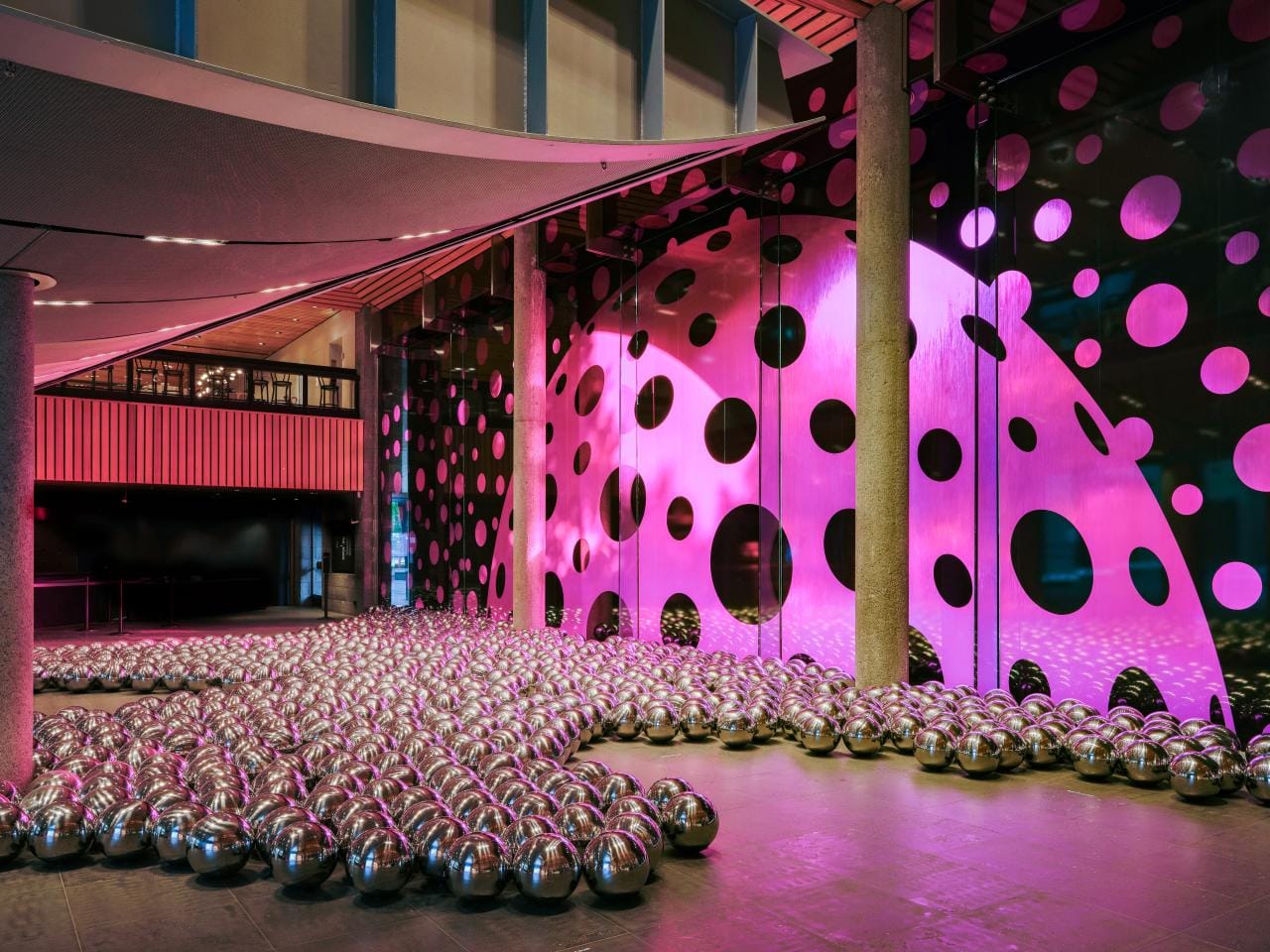
The work was a provocation aimed at the commercial art world, but its title also points back to the viewer. People were drawn towards objects that returned their own image. Decades later, that impulse would become central to the way millions encountered Kusama's work.
Putting ourselves back in the picture
The first Infinity Mirror Room appeared in 1965. Mirrors allowed Kusama to do something that painting alone could not: repetition no longer needed to be produced mark by mark. A limited number of objects could multiply apparently without end, while the visitor became caught inside the same visual field.
Today, that experience comes with another layer. Step inside an Infinity room and the body seems to dissolve into reflections, colour, and light. Then the phone comes out, the camera turns around and the indiviudal is placed firmly back at the centre.
Kusama could not have anticipated Instagram, but she understood the seduction of reflection, spectacle, and infinity. That makes the extraordinary popularity of her later work more complicated than the idea that social media simply cheapened it. The desire to photograph ourselves inside these environments sits strangely close to ideas Kusama had already been probing for decades. It also explains why stopping at the selfies misses so much.
Art as a way to live
Running beneath Kusama's experimentation was a difficult relationship with her own mind. She spoke openly about hallucinations, anxiety, and obsessive thoughts, and repeatedly described making art as a means of managing them. After returning permanently to Japan in 1973, she voluntarily entered a psychiatric hospital in Tokyo in 1977. She continued to live there while maintaining a studio nearby, where she would work for decades.
This part of her biography is essential, but it can also become another shortcut for explaining who Kusama was. She did not spend more than seven decades simply illustrating mental illness. The hallucinations mattered, as did the therapeutic role she attributed to making art, but she transformed those experiences into a much broader investigation of infinity, accumulation, sexuality, the body, death, consumerism, and the unstable boundary between the individual and everything around them.
Her mental health also complicates the familiar mythology of the suffering artist. Kusama did not present distress as a prerequisite for creativity. She described art as something that helped her endure it. The distinction matters. Her practice was not valuable because she suffered, making it was one of the ways she lived with that suffering.
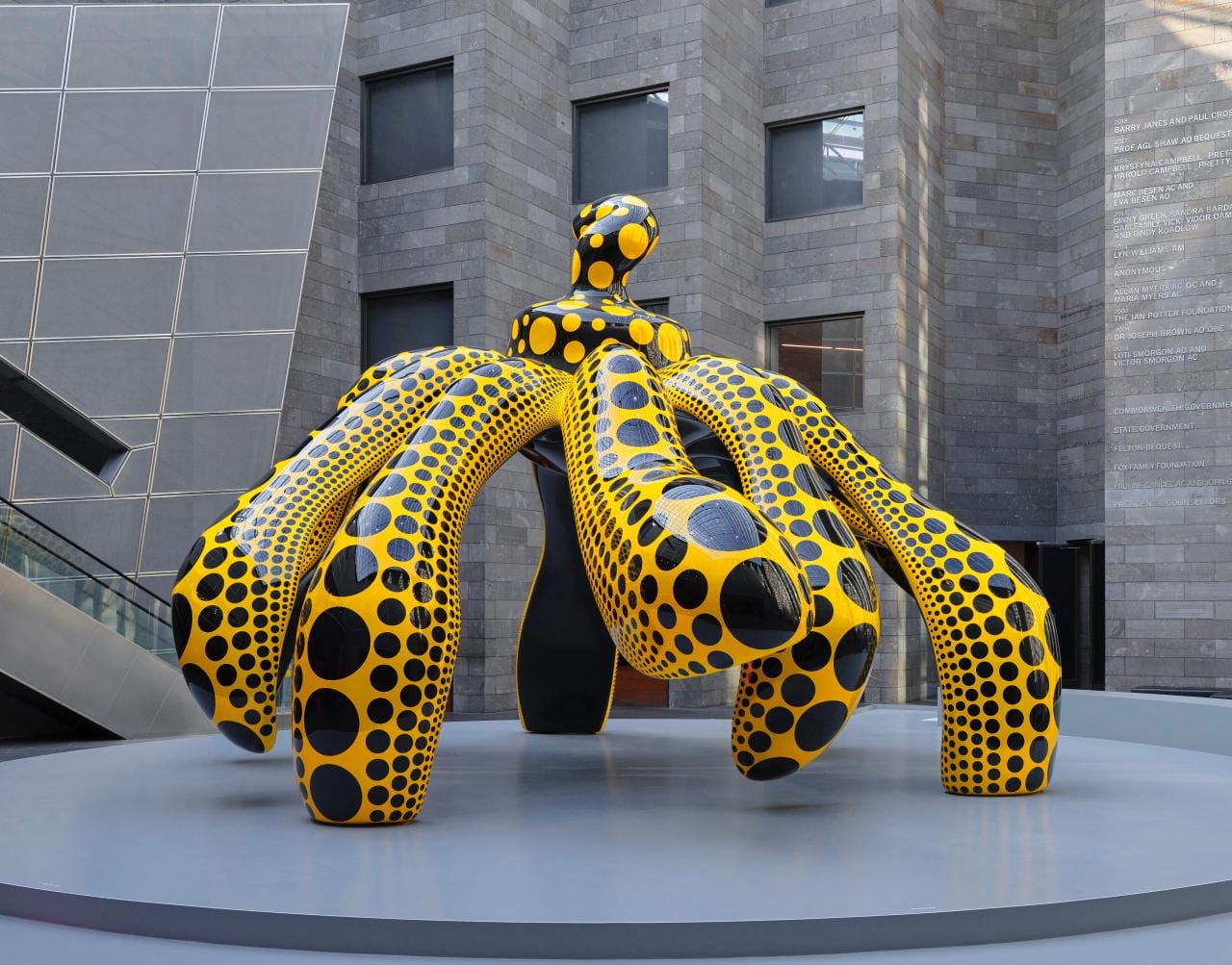
And she kept making it. After periods in which her international profile had faded, Kusama returned to enormous global prominence later in life. The pumpkins grew monumental, mirrored rooms travelled internationally, and dots escaped the canvas entirely. What changed most dramatically was the size of the audience looking back at them.
That audience now forms part of her legacy.
There is nothing inherently shallow about encountering Kusama through a pumpkin, a photograph, or an Infinity Room. Her later work is playful, accessible, and spectacular because she made it that way. The problem comes when recognition replaces understanding and seven decades of experimentation collapse into a decorative pattern.
For students encountering Kusama, this distinction is particularly important. Copying a polka-dot pumpkin teaches what a Kusama looks like. Following the dots through the Infinity Nets, self-obliteration, the radical performances of 1960s New York, Narcissus Garden, and the Infinity Rooms reveals what she spent a lifetime doing with them.
Perhaps that is the more fitting way to remember an artist so closely associated with infinity. Kusama repeated the same forms without simply repeating the same idea. Dot moved between hallucination and abstraction, bodies and environments, disappearance and spectacle. Mirrors could dissolve the individual while making us unable to look away from our own reflection.
Millions eventually stepped inside that world and took photographs of themselves. Kusama had spent decades showing how strange that desire was.