Table of Contents
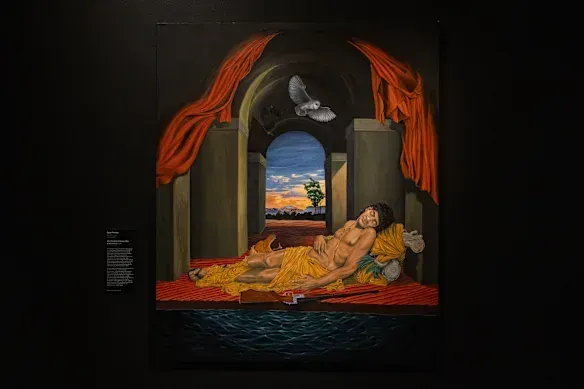
When you first look at Ryan Presley's, Our lifestyle of tranquility undisturbed, you might agree with the thought that it could belong to another century.
In the painting, a figure reclines beneath an archway, wrapped in rich, yellow fabric. A dog resides nearby while an owl crosses overhead. The scale, composition, and usage of oil paints recall the grandeur of European Renaissance art. However, if you look a bit closer, the details begin to disrupt the scene. A rifle sits within reach, dark waters stretch across the foreground, and in the distance, a bushfire burns against an orange sky.
This painting has earned Presley, a Marri Ngarr artist born in Mparntwe/Alice Springs, the $100,000 Telstra Art Award at the 2026 National Aboriginal and Torres Strait Islander Art Awards (NATSIAA).
The beauty of the piece makes this win indisputable, however, the work itself raises an interesting question. What happens when a First Nations artist takes the visual language of Western art history and uses it to reconsider whose version of history we inherit?
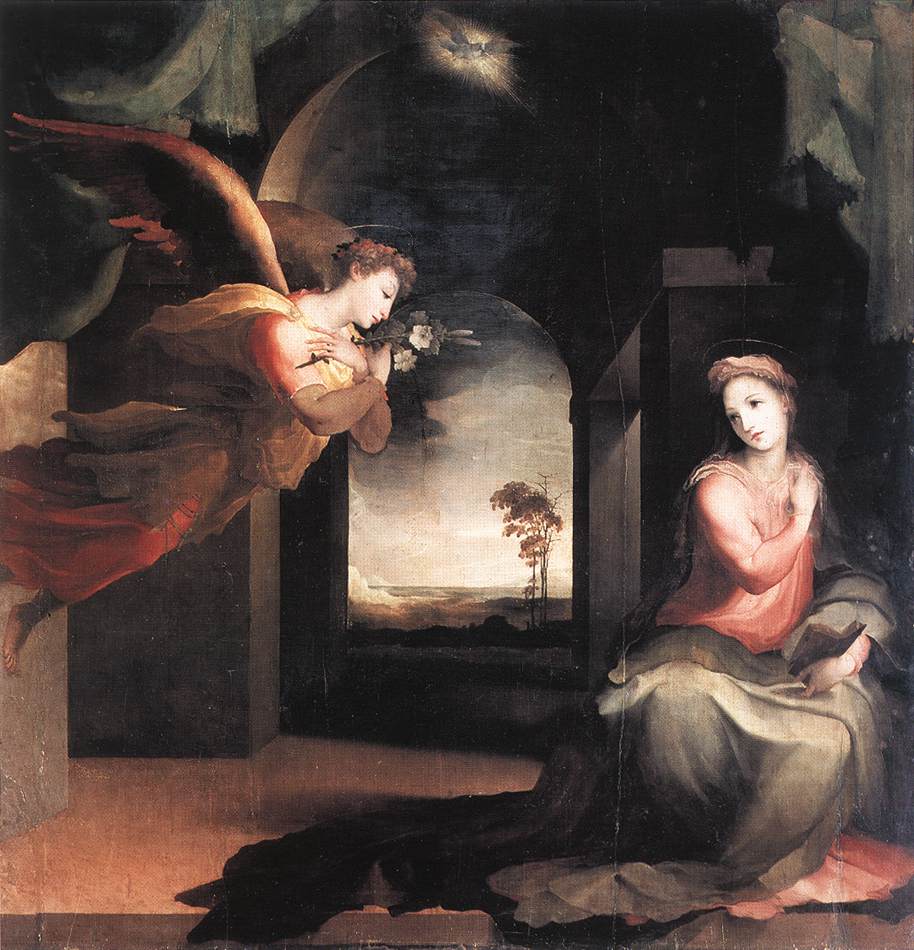
Presley drew partly on Renaissance paintings, including Domenico Beccafumi's 16th-century The Annunciation. European art from this period helped establish visual conventions that museums and art schools still teach today. Presley borrows that familiarity, but does not reproduce it. He shifts its symbols and timelines until the scene becomes difficult to place firmly in the past or present.
That uncertainty is deliberate. Presley has linked the work to George Orwell's 1984 and its famous warning about the relationship between power, history, and control. Past, present, and future appear to coexist within the painting, asking his audience to consider how accounts of history are constructed and who has historically been given the authority to construct them.
This becomes particularly pointed in an Australian context. For generations, First Nations people were frequently represented through perspectives of non-Indigenous artists, writers, governments, and institutions. Presley reverses this relationship. Rather than positioning European art as the authority through which other cultures are interpreted, he treats the Western canon as a material that can be examined, borrowed, and rearranged.
The NATSIAA judges recognised this complexity, highlighting both the painting's technical precision and its layers of cultural and art-historical references. At 2.8 square metres, it also commands the kind of physical presence traditionally associated with history painting, a genre once reserved for biblical stories, mythology, and the achievements of powerful European figures.
Presley was not alone in questioning inherited histories at this year's awards. Work on Paper winner, Jenna Mayilema Lee, transformed British Museum maps into six danala, or dillybags, confronting the collecting practices of institutions built partly through the removal of cultural material. Other winners examined Country, cultural knowledge, and environmental change through bark paintings, recycled road signs, and traditional materials.
Together, these works complicate any narrow expectation of what contemporary First Nations art should look like. Cultural knowledge can be carried through traditional practices, but artists can also work through Renaissance painting, museum archives, and materials associated with colonial systems.
That is what makes Presley's win particularly compelling. Our lifestyle of tranquility undisturbed does not reject Western art history. It enters directly into conversation with it, borrowing its scale, beauty, and authority while refusing to accept its version of history as fixed. The result is a painting that looks backwards without staying there.