Table of Contents
Eighteen objects stolen from the Kingdom of Benin more than a century ago have been finally returned to Nigeria by three Swiss Museums, following several years of research into how they entered European collections.
Fourteen came from the Ethnographic Museum at the University of Zurich, while the Museum Rietberg Zurich and the Musée d'Ethnographie de Genève returned two each.
The objects belong to the group commonly known as the Benin Bronzes, although the name covers thousands of works made from materials including brass, bronze, and ivory. Created at the royal court of Benin from the 16th century onwards, they served religious, political, and ceremonial purposes.
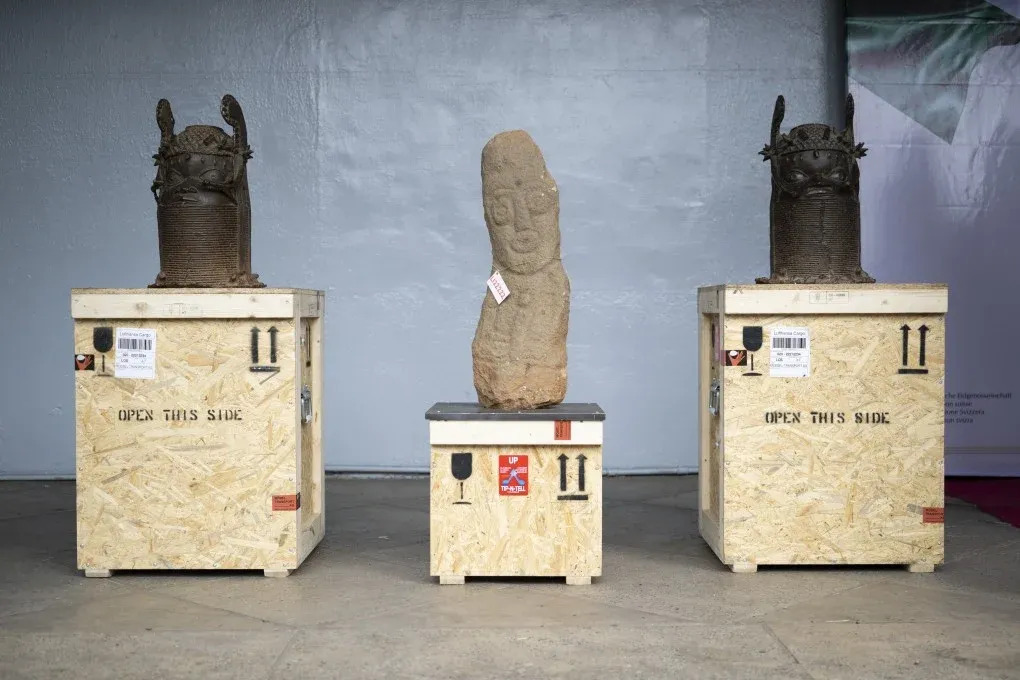
Among the returned works is an Eroro bell, a type worn by Benin warriors to signify rank, and a medicinal container depicting Ofoe, the divine messenger of death.
Their journey to Switzerland can be traced back to 1897, when British forces attacked Benin City, and looted thousands of objects from the royal palace. Many were subsequently sold and dispersed among museums and private collections throughout Europe and elsewhere.
The Swiss objects were investigated through the Benin Initiative Switzerland, a research project launched in 2021 and led by Museum Rietberg. Eight Swiss museums worked alongside Nigerian partners to examine the provenance of Benin objects in their collections. Researchers concluded that the 18 returned works were most likely taken during 1897 attack before entering the international art market.
The restitution was formalised at the National Museum in Lagos in June. Switzerland also returned five separate Nigerian objects held by the state after being seized during criminal proceedings, including four archaeological monoliths and a bronze bracelet.
The return is part of a much larger shift taking place across European collections. Germany agreed in 2022 to transfer ownership of more than 1,000 Benin Bronzes to Nigeria, while the Netherlands returned 119 works last year. The University of Cambridge has also returned 116 objects from its collection.
The restitution also raises the question of what happens once these items return home. Some of the Swiss returns will remain on display at the National Museum in Lagos, however, most will travel to Edo State and be temporarily housed at the National Museum in Benin City. Nigeria's National Commission for Museums and Monuments plans to establish a gallery bringing together recently returned Benin works, including those from Switzerland, the Netherlands, and Cambridge.
Not every object covered by the Swiss project will physically leave Switzerland. Ownership of 28 works were transferred to Nigeria in March, but nine will remain on loan at Museum Rietberg and another at Musée d'Ethnographie de Genève.
Switzerland and Nigeria also used the restitution ceremony to sign an agreement addressing the illicit trade of cultural property. It creates framework for future returns, information sharing and cooperation between the two countries.
That makes this return significant beyond the number of objects involved. Provenance research established how the works were probably acquired, ownership was transferred to Nigeria, and some will continue to be exhibited in Switzerland and Nigeria's consent.
It offers a different model for museums holding contested collections. Research where objects came from, return ownership when the evidence warrants it, and allow the communities they belong to to decide what happens next.