Table of Contents
Tate Modern's Turbine Hall has hosted some of contemporary art's most ambitious installations. Its enormous industrial interior has been filled with sunlight, artificial fog, and millions of porcelain sunflower seeds. Now, Lebanese artist and composer, Tarek Atoui, has taken on the space with an orchestra of suspended horns, enormous drums, bamboo pipes, and vibrating stones. The instruments play without conventional musicians, producing an evolving composition that visitors can hear, feel, and inhabit.
Opening on 13 October 2026, Hyundai Commission: Tarek Atoui is the eleventh installment of the museum's annual commission series. The exhibition brings together traditional instrument-making techniques, experimental technology, and contributions from craftspeople and musicians across Asia and Europe. Atoui, who was born in Beirut in 1980 and is now based in Paris, has spent more than two decades investigating the possibilities of sound through sculpture, performance, and collaboration.
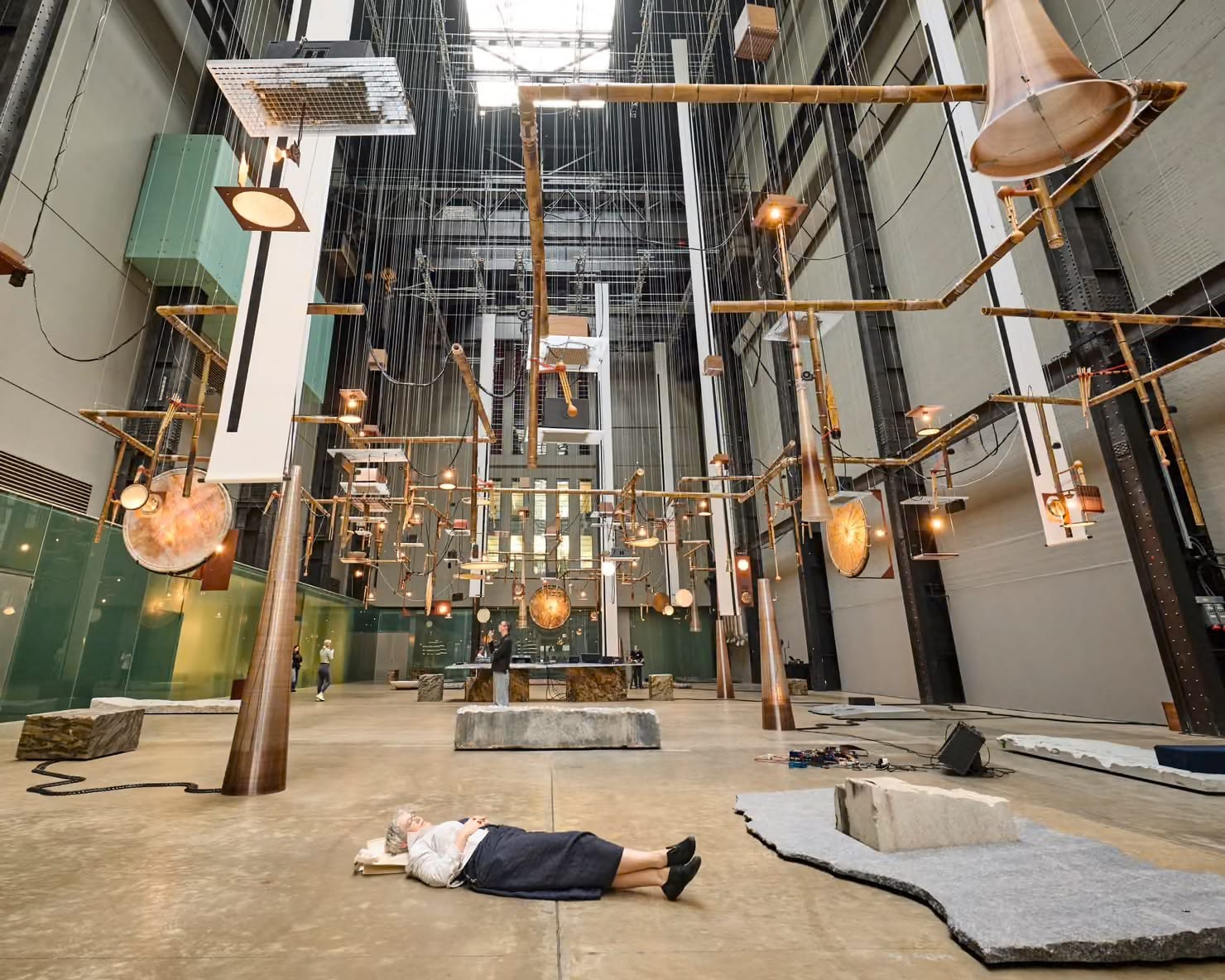
Much of the installation's ingenuity lies in how its instruments operate. A network of bamboo pipes suspended overhead connects approximately 75 shengs of traditional mouth organs associated with East and Southeast Asia. Motorised blowers send air through the instruments, producing sustained chords and subtle variations in pitch. Nearby, oversized Korean drums respond to changes in heat and tension while elongated brass horns inspired by the Central Asian karnai project sounds across the hall. Microphones and custom-built software capture and redistribute these noises, allowing individual instruments to influence the larger composition.
The materials themselves are equally important. Thirty-metre textiles developed with designer, Satoshi Kondo and Issey Miyake, incorporate conductive ink that generates low-frequency sound as the fabric responds to air currents. Stone slabs, some fitted with speakers, transmit vibrations through their surfaces. Visitors are encouraged to sit or lie on them, experiencing frequencies that may be difficult to hear but can be registered physically.
This approach has developed through Atoui's longstanding collaboration with deaf and hard-of-hearing communities. Workshops with students at the Amal School for the Deaf in Sharjah, United Arab Emirates, helped shape his understanding of listening as an experience involving the entire body. His work questions the assumption that music must be heard through the ears to be understood or enjoyed. At Tate, the resonating stones and low-frequency vibrations make that research tangible, although they do not necessarily offer the same experience to every visitor.
The Turbine Hall exhibition also presents its own acoustic challenges. Thousands of people pass through the building, bringing conversations, footsteps, and other unpredictable sounds into an already reverberant space. Atoui has incorporated these conditions into the installation's design, alongside fluctuations in temperature, humidity, and airflow. More than 40 musicians are expected to contribute performances throughout its six-month run, continually introducing new sounds and arrangements.
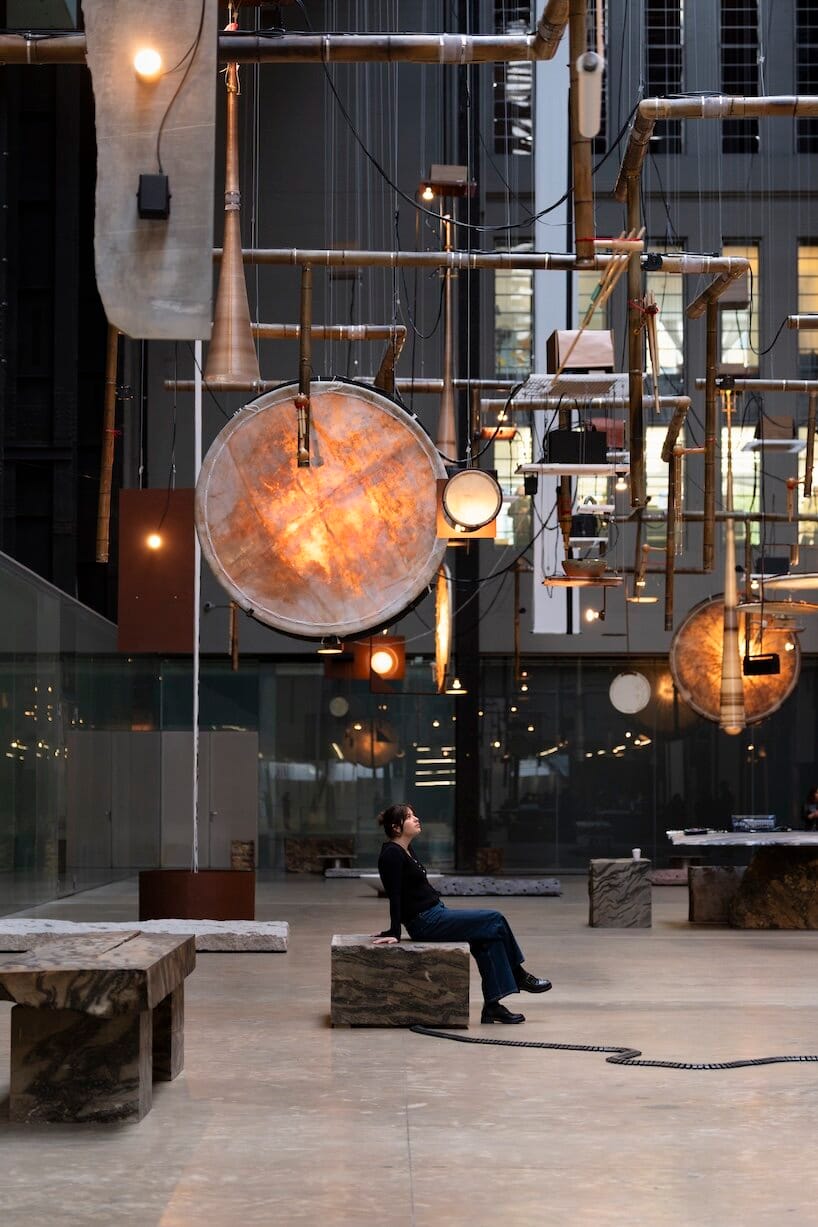
There is a considerable amount of technology involved, yet the exhibition remains closely connected to the traditions and communities responsible for its instruments. Atoui's collaboration with Korean drum makers, Asian mouth-organ specialists, and contemporary designers acknowledge that musical knowledge develops through exchange, adaptation, and experimentation. The installation's scale may initially command attention, but its complexity becomes apparent through sustained listening.
Atoui has created an artwork that cannot be fully experienced in a single glance or reduced to one definitive performance. Its composition changes throughout the day, shaped by mechanical systems, environmental conditions, and human activity. In a museum space usually associated with monumental visual spectacles, he asks visitors to spend time with somethig less predictable. The sounds already surrounding them, and the possibilities of listening more closely.
Hyundai Commission: Tarek Atoui is on display at Tate Modern, London, from 13 October 2026 to 11 April 2027. Admission is free.