Table of Contents
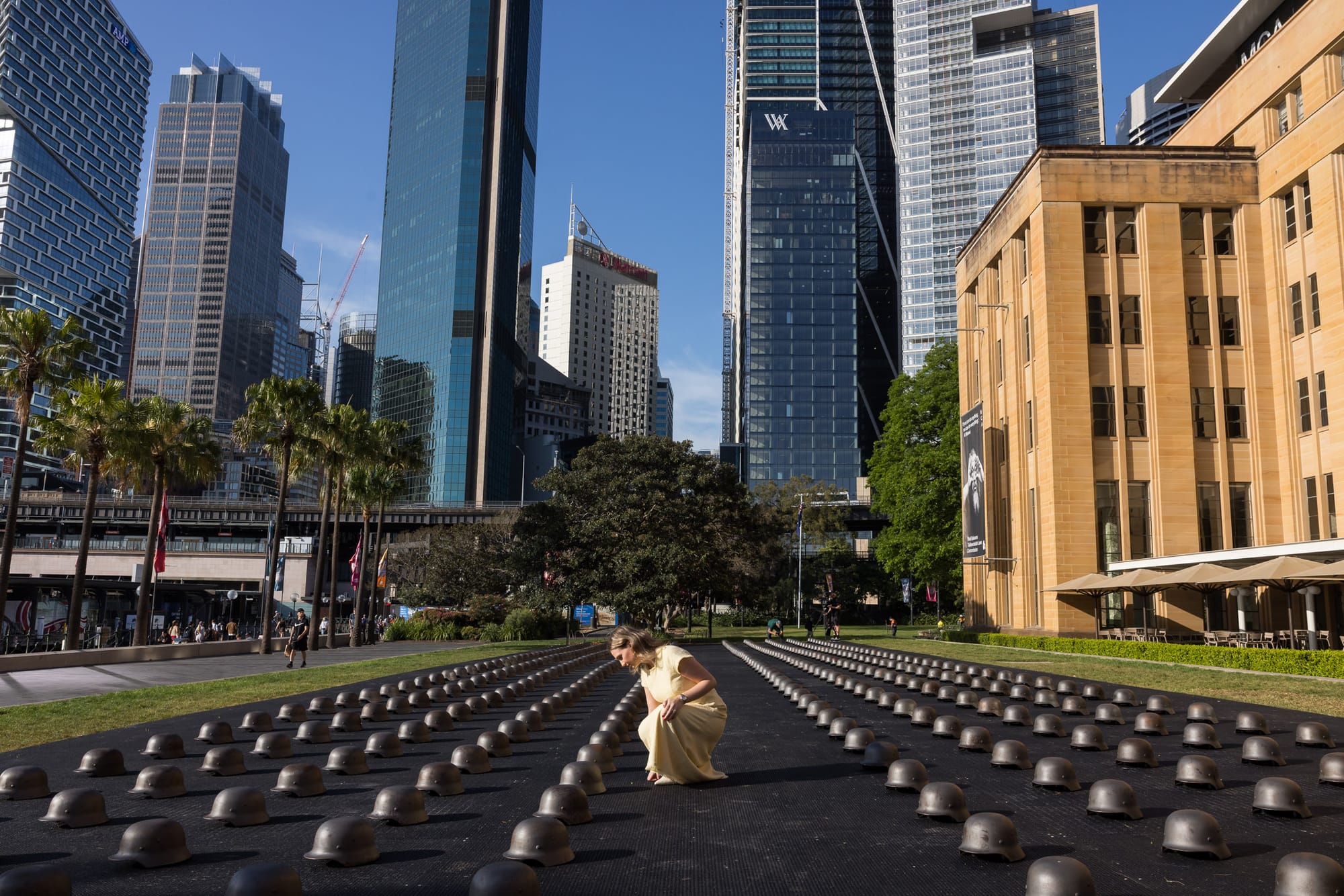
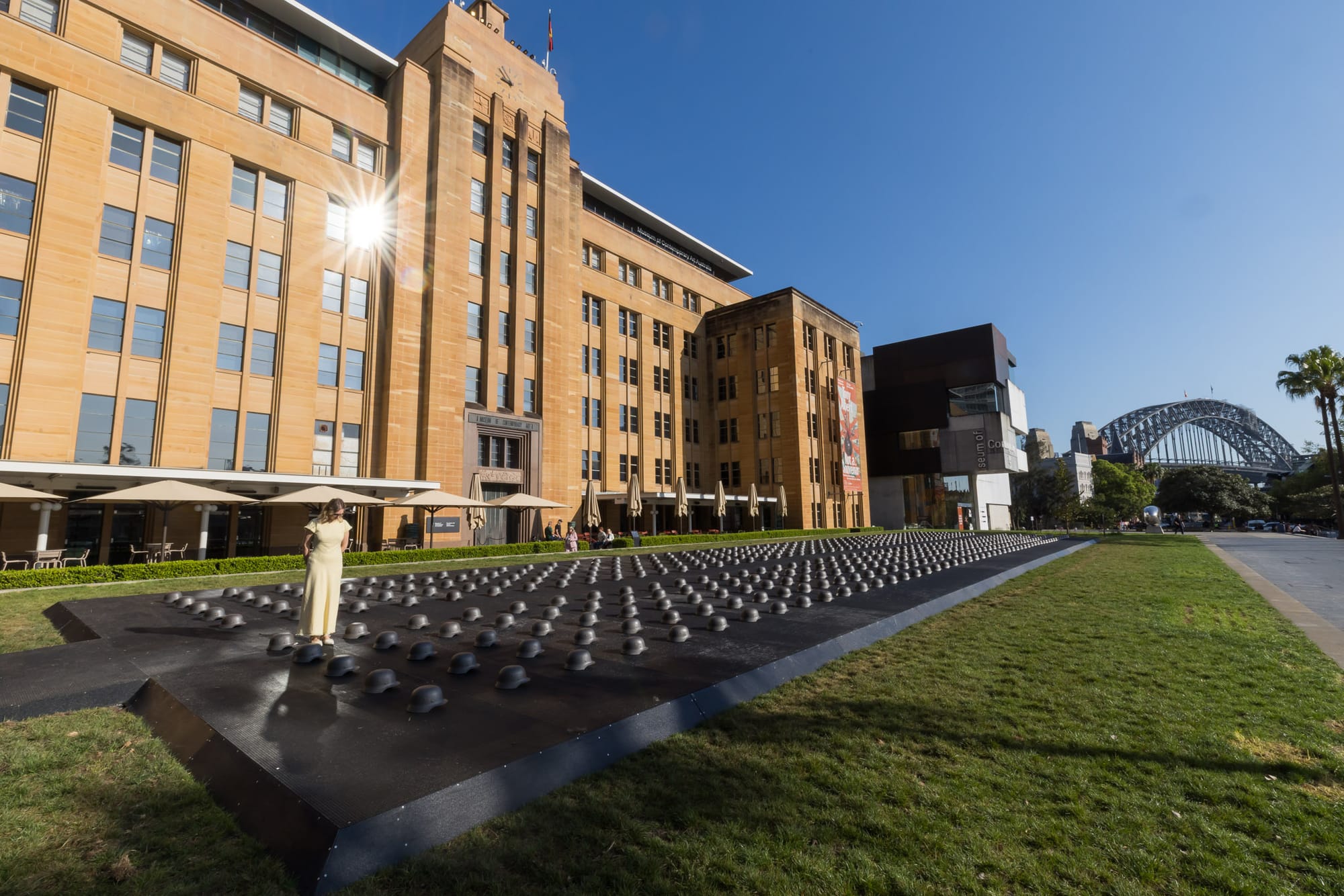
Five hundred combat helmets now sit in regimented rows beside Sydney Harbour. Cast in iron and identical in form, they stretch 40 metres across the Tallawoladah Lawn outside the Museum of Contemporary Art Australia, with the Opera House and Harbour Bridge visible beyond them. It is an uneasy interruption to a place usually associated with tourism, leisure, and postcard views of the city.
The installation is Mushrooms, Ai Weiwei's new work for the 2026 Neil Balnaves Tallawoladah Lawn Commission. Its title begins with the visual resemblance. The rounded military helmets resemble mushroom caps. Ai has then extended this association through ideas of decay and regeneration, a mushroom cloud of nuclear warfare and a Chinese expression connected with delay and waiting. Together, those meanings turn a familiar piece of military equipment into something far less stable. A helmet can signify protection, but its existence also assumes the possibility of violence.
That contradiction has occupied Ai for years. While making his 2017 documentary, Human Flow, which followed displaced people across 23 countries, he became increasingly interested in the wars driving mass migration. He began researching contemporary weapons and military systems and has since travelled to Ukraine, including visits to soldiers near the frontline.
One episode in particular has stayed with him. As Russia amassed forces around Ukraine in early 2022, Germany offered the country 5,000 military helmets. The gesture was widely criticised at the time as inadequate against the threat Ukraine faced. Ai saw something revealing in the mismatch between the scale of the danger and the response to it. Those helmets eventually became one of the starting points for Mushroom.
In Sydney, they have multiplied into 500 cast-iron sculptures, produced from a single mould and arranged in ten uniform rows. Visitors can walk along a central passage through them. Their repetition initially creates order, but it also strips the helmet of its connection to an individual wearer. What remains is an unsettling inventory of protection, waiting for the conflict that makes protection necessary.
The location sharpens that unease. Across the water stands the Sydney Opera House, a building Ai has associated with peaceful civic life and cultural enjoyment. On the lawn, the helmets insist on another reality. Wars continue while life elsewhere proceeds with remarkable normality. For Ai, that distance is part of the problem. He has spoken about the ease with which people can know about injustice and conflict without allowing that knowledge to disturb their daily lives.
Mushrooms therefore arrives alongside a much broader criticism of contemporary culture. Speaking to The Guardian around the installation's unveiling, Ai dismissed much of the art circulating through institutions and the art world as "decorative and sentimental". his alternative was uncompromising, "Real art questions the existing order."
It is a useful standard against which to consider Mushrooms, including its contradictions. Ai is one of the world's most prominent contemporary artists, and his criticism of institutional culture is being expressed through a major museum commission in one of Sydney's most prestigious public locations. The MCA has promoted the installation as an opportunity for reflection and dialogue and developed a public program around peace, hope, and resilience. An artwork concerned with war has entered the organised, supported, and carefully mediated environment of the institution Ai criticises.
That does not make its politics meaningless. It does, however, expose a difficulty facing political art today. Images of war, displacement, and protest circulate constantly, while museums regularly present work concerned with injustice, power, and identity. Political subject matter alone cannot guarantee that an artwork challenges anything. Once dissent become familiar within cultural institutions, the harder task is finding a way to interrupt the habits through which audiences consume it.
Mushroom attempts that interruption through physical presence.Its helmets occupy the same public space as people walking through Circular Quay, visiting the museum or photographing the harbour. There is no distant battlefield depicted and no individual victim whose experience can be observed from afar. Instead, Ai has placed the equipment of war directly into an ordinary civic landscape.
Perhaps that is where his claim about "real art" becomes most demanding. Questioning the existing order is not simply a matter of choosing a political subject or declaring opposition to war. It requires art to unsettle what has become normal, including the ability to acknowledge distant suffering and then continue unaffected.
Mushrooms cannot stop war, and Ai does not pretend that art holds that power. What it can do, however, is make indifference slightly harder to maintain. Against one of Sydney's most comfortable and familiar views, 500 iron helmets remain lined up on the lawn, waiting. The question is how long we are prepared to look at them before they, too, become part of the scenery.
Mushrooms is on display on the Tallawoladah Lawn outside the Museum of Contemporary Art Australia until April 2027.