Table of Contents
Art Minute
Drawing
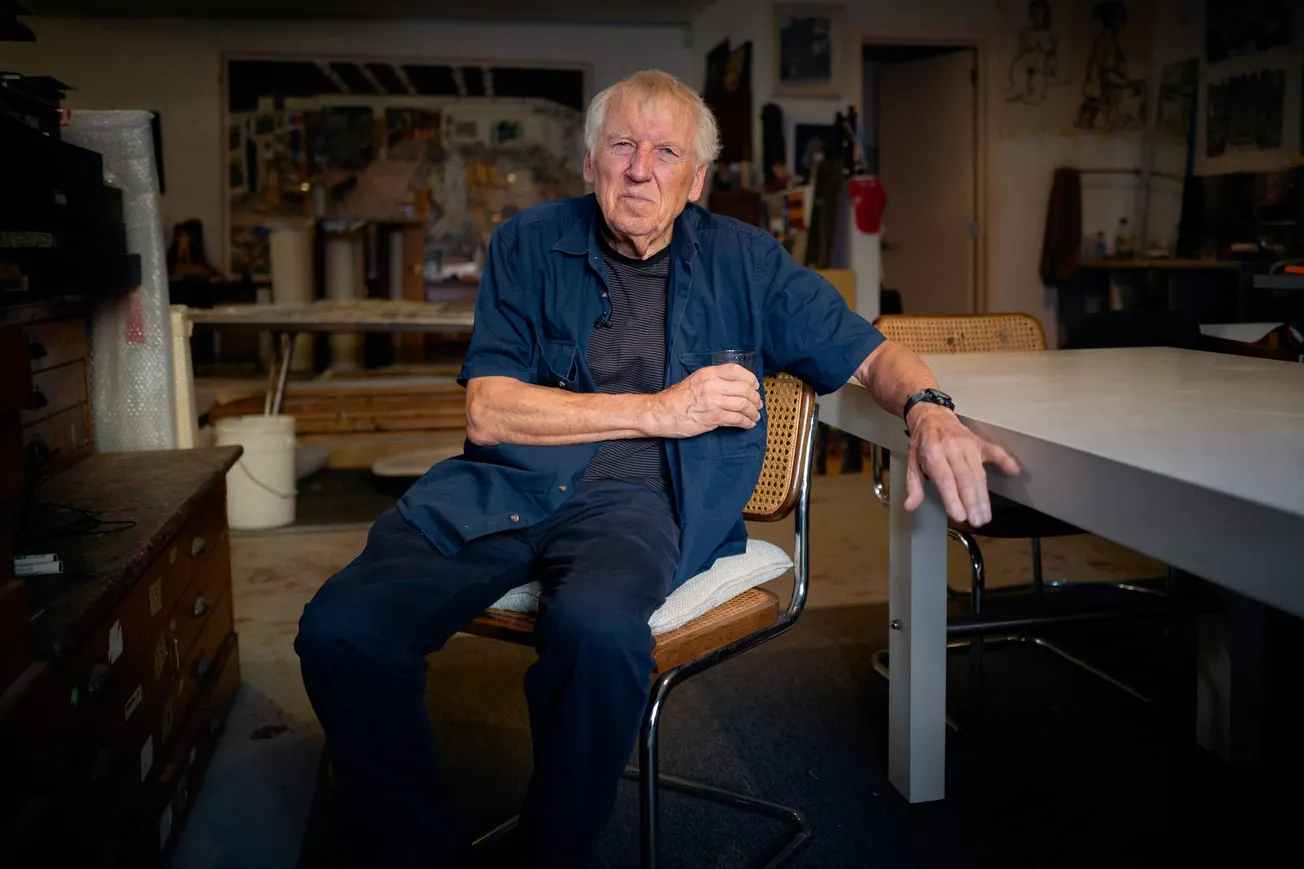
| Title: | Jan Senbergs - Drawing |
|---|---|
| Duration: | 20:00 |
| Year: | 2020 |
| Director/DOP: | Peter M Lamont |
| Music: | Stephen Magnussen, Lachlan Davidson, Peter M Lamont |
| Camera: | Sony F3 |
About Jan Senbergs
Early Life and Background
Born in Latvia in 1939, Jan Senbergs and his family were displaced during World War II, eventually migrating to Australia in 1950. Settling in Melbourne, the young Senbergs was exposed to the city's industrial landscapes, which would later become a central theme in his artwork.
Artistic Development and Education
Senbergs attended Richmond Technical School, where he studied technical and free drawing. At 15, he began an apprenticeship in silkscreen printing, a skill that significantly influenced his early artistic practice. His proficiency in printmaking laid the foundation for his transition into painting and drawing, allowing him to explore various mediums throughout his career.
Major Works and Exhibitions
Throughout his career, Senbergs produced a vast body of work, including notable pieces such as "Altered Parliament House 1" (1976) and "Kitchen at Smacka's" (1976). He represented Australia at the São Paulo Biennale in 1973 and was commissioned to create a large-scale mural for the High Court of Australia in Canberra in 1980. In 2016, the National Gallery of Victoria held a comprehensive retrospective titled "Jan Senbergs: Observation–Imagination," showcasing over 120 works from his extensive oeuvre.
Style and Technique
Senbergs' art is characterised by a humanist vision and a finely-honed sense of the absurd. His works often depict industrial cityscapes, ports, and natural landscapes, employing a blend of figuration, surrealism, expressionism, and abstraction. His technical skills in silkscreen printing informed his approach to painting and drawing, resulting in a distinctive style that captures the complexity of human interaction with the environment.
Legacy and Influence
Senbergs' contributions to Australian art are significant, with his works held in major institutions such as the National Gallery of Australia and all state galleries. Internationally, his art is included in collections like the Museum of Modern Art in New York and the National Gallery in Washington D.C. His exploration of industrial and urban themes has influenced subsequent generations of artists, cementing his legacy as a pivotal figure in contemporary Australian art.