Table of Contents
There is a version of the music business that gets written up in clean lines. Kid from the suburbs gets discovered, kid gets a deal, kid gets a hit, kid gets a tour bus. Sam Fischer's story has all of those beats. It just refuses to arrange them in the right order.
He was born in 1991 on a farm in Grose Vale, an hour or so out of Sydney, the son of two doctors. He started on violin at three, picked up the saxophone at ten, and was writing songs by twelve. By eighteen he had a scholarship to Berklee College of Music in Boston, which is where most of this story actually starts. He moved to Los Angeles after graduating and spent years getting nowhere fast. He slept on whatever soft surface presented itself, drove a delivery van for an Australian meat pie shop downtown, and took every session that would have him.
Then he wrote a song called "This City" on a day he felt thoroughly beaten by Los Angeles. He put it out himself in early 2018. Nothing happened. About eighteen months later, TikTok happened, and a quiet little ballad about loneliness in a big town turned into a global hit. RCA signed him. The song charted across the UK, Australia and beyond. Demi Lovato, Meghan Trainor and Lewis Capaldi started passing it around. His debut album, I Love You, Please Don't Hate Me, finally landed in late 2023, years after the song that built the runway for it.
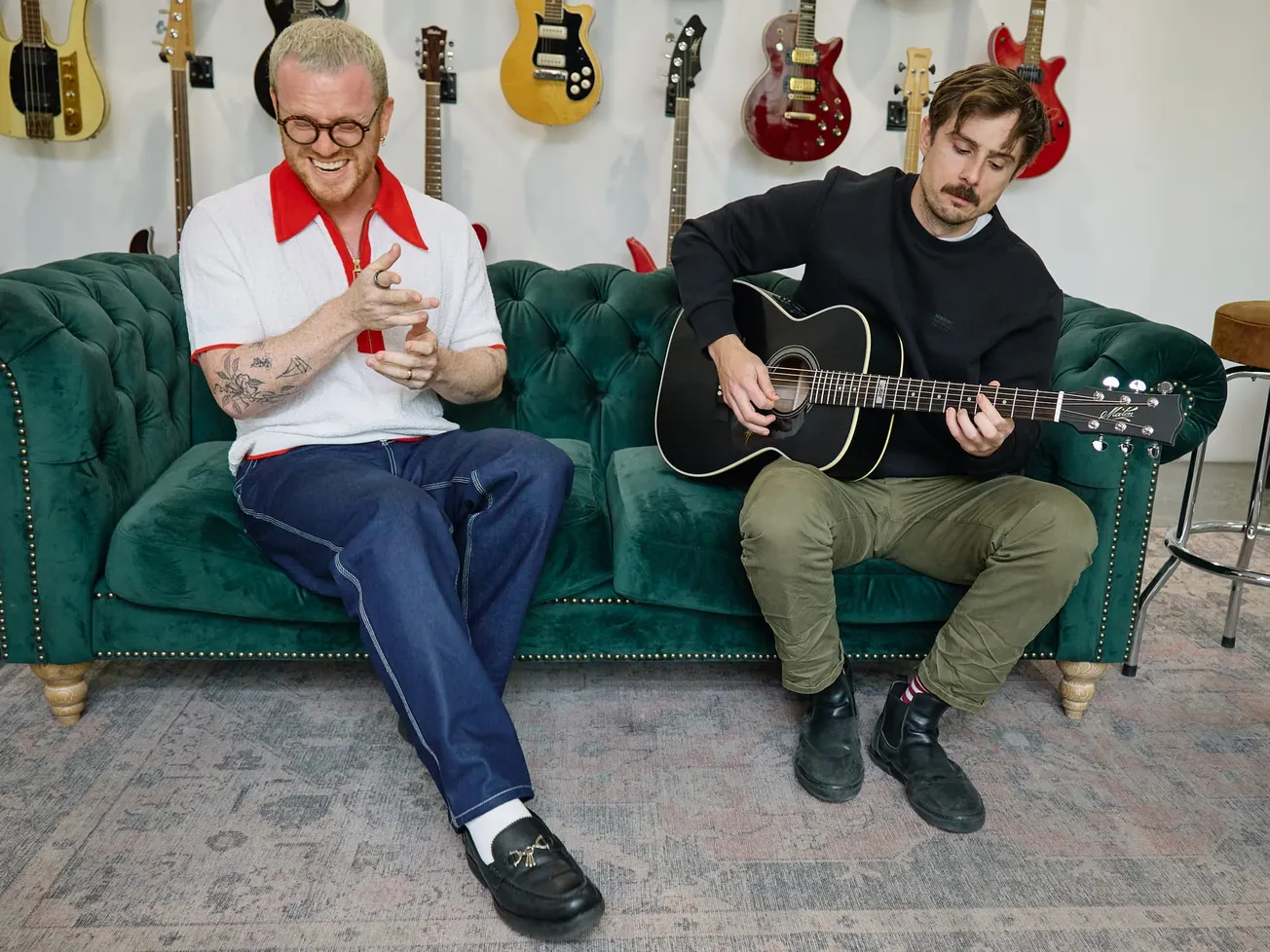
What follows is a conversation with Sam and his musical director and guitarist, Marton Bisits, about the part of the story the clean version always leaves out. The rooftop, the rain, the hundred kilos of luggage, and the flattened guitar. The slog.
The Rooftop
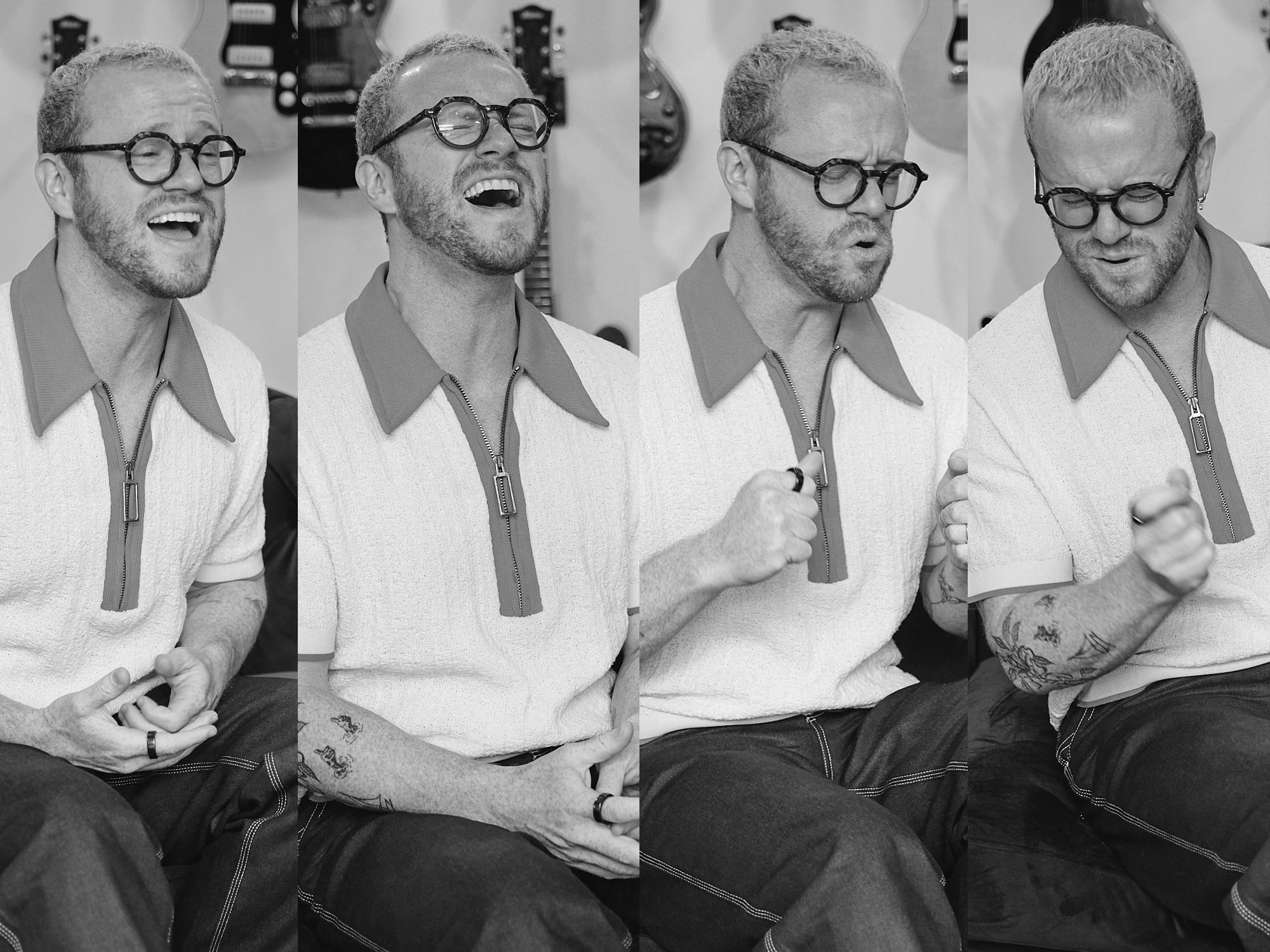
Ask Sam how he met the man who has played beside him for the better part of fifteen years, and you don't get a polished origin myth. You get a roof and a beer.
"We actually met in college overseas in Boston," Sam says. "It was like our first summer in Boston and we were drunk on a rooftop and I heard an Australian accent behind me. And I turned around and I said, who are you? And he was like, I'm Marton. And I was like, what are you doing? And he said, I play guitar. And I said, well, I need a guitar. And he goes, all right."
Two Australians, same year at Berklee, same rooftop by pure accident. Marton remembers the slow burn that followed. They stayed in touch. Then, about a year and a half later, a message arrived asking him to come and play on Sam's EP.
For a while there wasn't much to play for. "You're in college, not much was going on for me as an artist," Sam says. "I didn't really know what I wanted to do yet." But the talk kept circling back to the same fantasy. One day they'd tour the world together. One day Sam would call and say it was on.
The call came after a false start. Sam moved to LA, signed his first record deal, and watched it dissolve inside nine months. He says, with no apparent bitterness, that he was thankful it got dropped. He'd written "This City" while he was tangled up in it. Two years later the song started its slow climb, Marton had just moved to LA himself, and Sam picked up the phone.
"I called Marton and I was like, I think it actually is on."
That was six years ago. Marton calls it studying for a degree in something nobody offers a degree in. Sam just calls it madness.
A Hundred Kilos Between Two People
For the last couple of years, the operation has been almost comically lean. Just the two of them, playing rooms anywhere from 200 to 11,000 people. Tiny clubs and big arenas, across Europe, the UK, all over Australia and the States.
Sam is plain about the economics. He couldn't afford to take more than Marton out on the road, so Marton became his musical director, his guitarist and his tour manager at the same time. Only now, at the tail end of a run supporting Australian artist Guy Sebastian, has Sam been able to bring on an actual tour manager and two background singers. The reason is the part people don't say out loud. Touring is brutally expensive, and the money at the end of it is rarely much at all.
So they did it the hard way. No Ubers, no private cars. Bus, train, flight, whatever moved them and their gear from one town to the next. There is one trip that has clearly become legend between them. Rotterdam to Munich, a hundred kilos of luggage split between two grown men. A guitar, two suitcases, big boxes of who knows what.
"In Munich, it was raining and it was one degree," Marton says.
"All hands on deck," Sam says. "Push and walking through the rain over cobblestones in Europe."
And then, at the end of it, a few thousand people. Marton shrugs at the symmetry of it. The rain and the cobblestones and the crowd are the same story, just different halves of the same day.
When they were lucky, there was a bus to sleep on. They opened for the Irish band Picture This in Europe and got a bus with bunks, which counted as luxury. The rest of the time it was showers in venue gyms, naps taken on the floor between soundcheck and stage, sleep grabbed on the move. You go to bed on the bus, you wake up in a new city, you do it again.
"Some people are built for it," Sam says. "And I don't blame artists who don't like to do it."
Marton agrees it isn't for everyone. What has kept it alive is something simpler than ambition. They get along. They spend at least three months a year in each other's pockets, and one year it was six. If they didn't like each other, Marton says flatly, they wouldn't be sitting here. Sam has known almost everyone in his band for years and years. Fifteen, in Marton's case.
The Heartbreak of Hindsight
The new record is the thing Sam is most proud of, and he says so without the usual hedging.
His first album had a tortured birth. "This City" came out in early 2018 and blew up in 2020. The album that should have ridden that wave took four or five years to actually arrive, and by the time it did, the press wanted a tidy story he no longer had the energy to tell. The truth, he admits, was less romantic. It was fifteen of the best songs he thought he had, thrown onto a record because he was sick of himself and sick of the process and tired of all the noise happening behind the scenes. He just wanted it out.
This time is different. This time it's focused.
"The heartbreak of hindsight kind of wraps the entire album," he says. He's thirty-five now, writing about the last few years of his own life. Starting over. Leaving LA for the UK. The relationships he lost and the ones that went through the fire and came back. It is, by his own description, deeply introspective. A view from the top, looking back down the climb.
"But there are some bangers on it," he adds, because of course there are.
Around ninety-five percent of it was written in the UK, produced by Dylan Nash, an Australian who's based over there. The recent single "A Heart Doesn't Hurt Itself" carries Nash's fingerprints, all clean space and a deeply introspective lyric—co-written with acclaimed UK artist Frances—that lands like a confession. The new material also picked up something Sam didn't have before. He's been pulled into UK rave culture and queer nightlife, and it bled into the writing.
Marton, who has watched the sound evolve from the inside, puts his finger on it. The band has always leaned organic. Drums, a bit of synth, but built around the lyric and a piano or guitar part. The newest stuff has a floor to it now. Something to dance to.
Flipping the Script
Both men are obsessed with one idea. The live show should never be karaoke.
"I want people to listen to the album, don't get me wrong," Sam says. "But when they come to experience it live, I wanna create a world."
His north star here is Beyoncé, who he reckons is simply the best at reimagining her records for the stage. The arrangements, the vocals, the band, the whole spectacle. So they take that ambition and shrink it to fit two people and a pile of luggage. The way they play "This City" every night is different from the way it sits on the record.
Sometimes it works. Sometimes, Sam says, it really doesn't. He remembers the opening night of a headline tour in Australia last year. They walked off stage and immediately started cutting. That song didn't work, so it's gone. That moment died, fix the transition. The show is never finished. It evolves as they do.
The Flattened Guitar
If there's one story that captures the whole adventure, it belongs to Marton and a guitar.
It starts with a Cole Clark he found on eBay in the States, sold by someone who clearly had no idea what they had. He loved it. Used it for everything, every late-night TV performance, the lot. It became one of the original Cole Clarks you can't buy anymore, and it quietly became valuable. So at the end of a long year, he decided to buy a backup. He got off a plane, picked up his guitar case, and felt something wrong before he even opened it.
"It looked like it had been steamrolled," Sam says.
"There was sawdust in it," Marton says. "That's how much it had been flattened."
The airline had crushed it. Marton connected with Cole Clark and got a replacement, but it wasn't the same. They'd changed the neck design and it didn't sound right. No hard feelings, he's careful to say, they still make great gear. It just wasn't his guitar.
The fix came through the Australian guitar world, which runs on favours and phone numbers. Through a guitarist named Dan Maher he got a number for Mark Mansour, head of artist relations at Maton, the legendary Melbourne guitar maker whose intruments have found their way into the hands of luminaries including Tommy Emmanuel, Neil Finn, Keith Richard and George Harrison. Marton texted him cold, half-apologising, asking if he could maybe drop by the factory while he was in town. Mark's answer was simply to mail him a loaner.
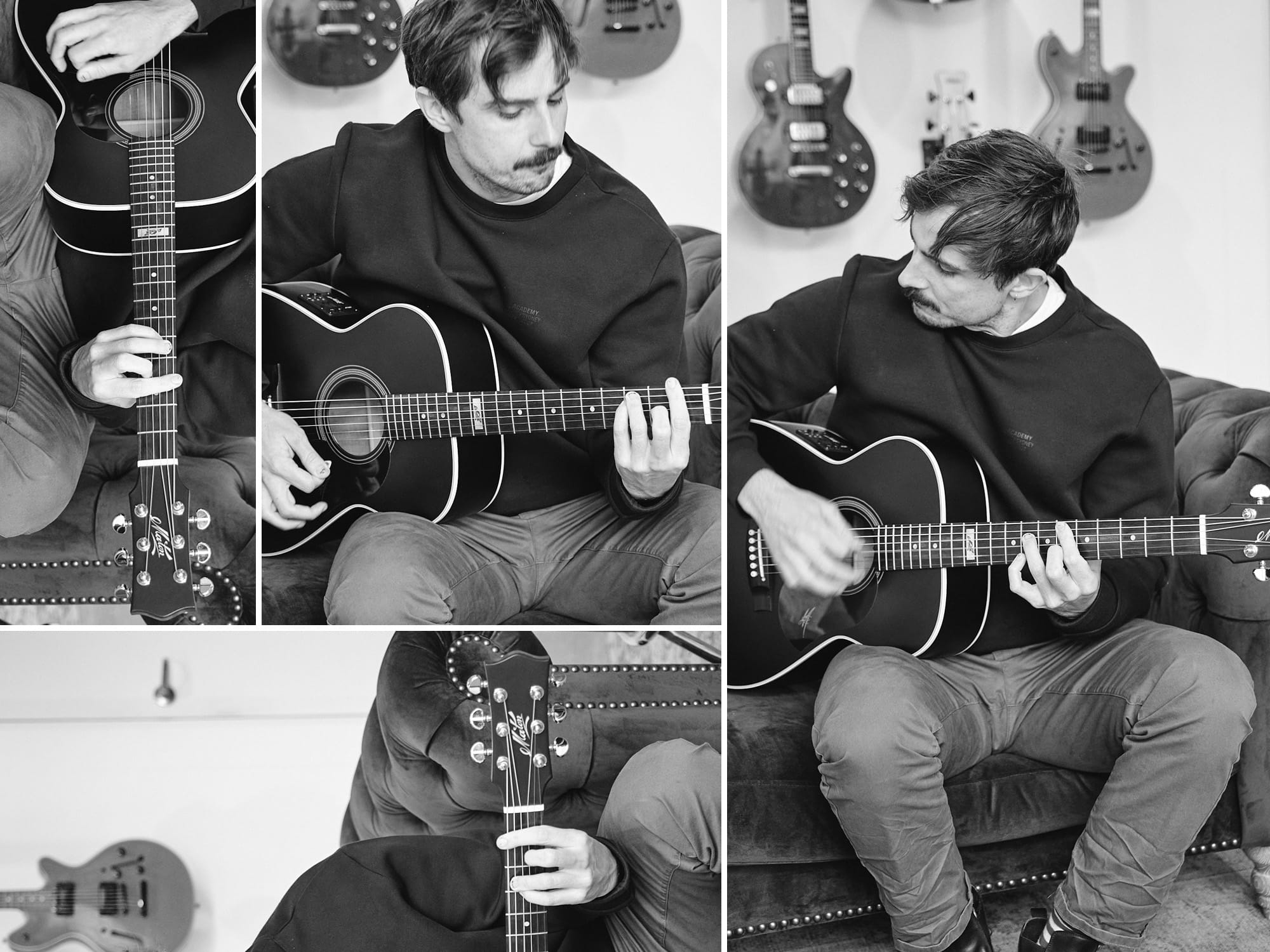
He loved the Maton, kept it, kept in touch. Before a big tour opening for Brett Young, he asked for another, came to the factory, tried a pile of them, and bought one. He's used it religiously ever since. Running it into a Kemper in stereo, he found the sound he'd been chasing for years. The first time he plugged the Maton into the Kemper, he says, was the first time a sound engineer told him it was finally right. "This is what we've been searching for."
There's a sweet footnote. Sam's very first guitar, bought when he was fifteen, was also a Maton. After the Cole Clark disaster he offered it up, and as Marton's clearly the real player of the two, it sits in his room now, still around, still sounding good.
Epilogue
The numbers tell you Sam Fischer is a success. A viral smash, a major label, collaborations with Lewis Capaldi and Demi Lovato, arenas across three continents. The transcript tells you something the numbers can't. Most of that was hauled across Europe by hand, in the rain, by two friends who met drunk on a rooftop and never stopped getting along.
What stays with you isn't the hit. It's the texture around it. The deal that mercifully collapsed. The five-year wait for an album that arrived too late to feel like a victory. The flattened guitar and the stranger who mailed a loaner to a man he'd never met. Sam is making the most focused record of his life at thirty-five, writing about everything he lost to get here, and he sounds genuinely happy about it. Not because it got easy, but because it never did, and he kept his friend the whole way through.
The city, the song goes, is always going to break your heart. The trick, it turns out, is who you're standing next to when it does.