Table of Contents
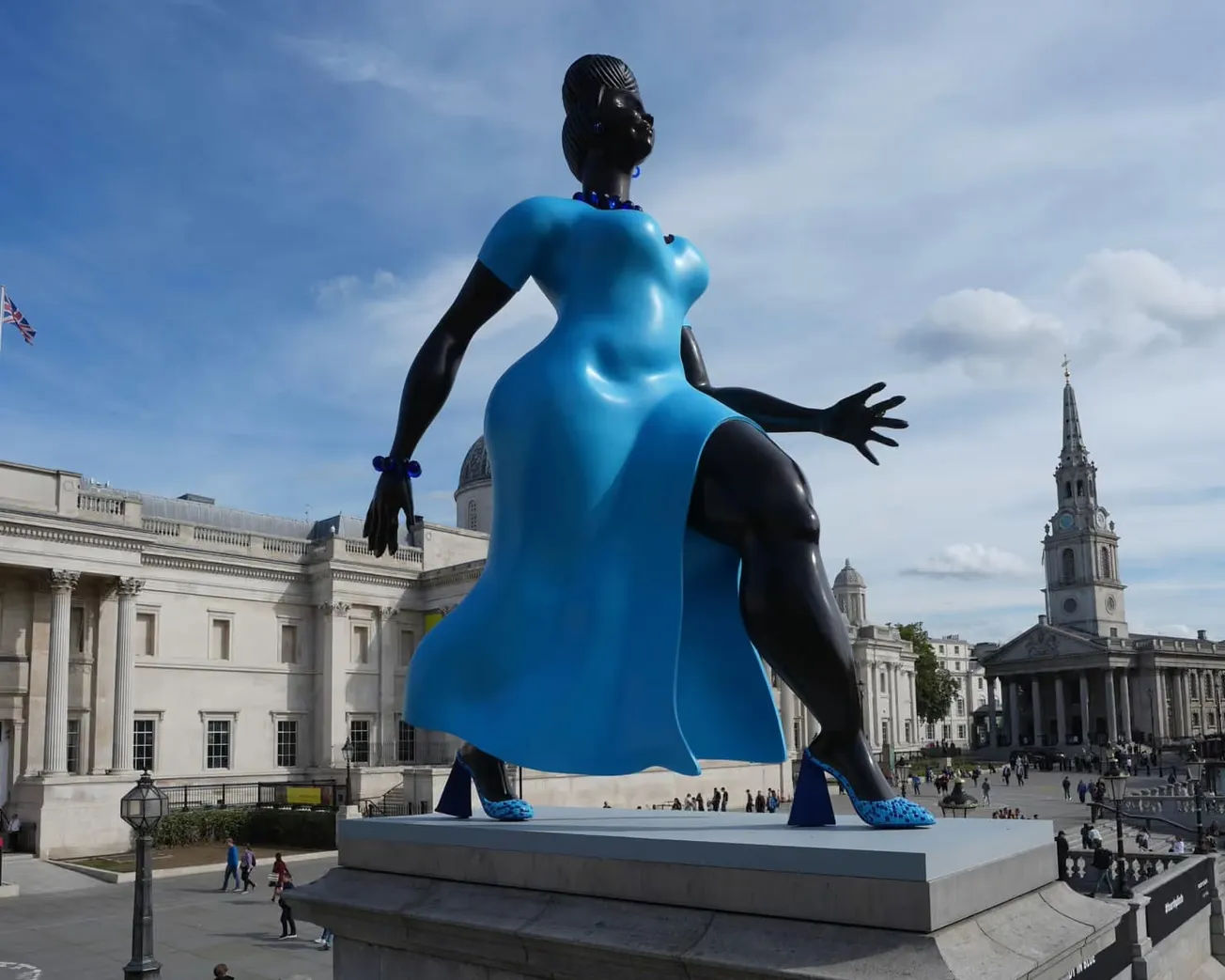
Tschabalala Self's Lady in Blue is doing something unusually ordinary for a monument. She is walking. There is no horse beneath her, no military uniform, no ceremonial pose, and no historical achievement that explains why she has been raised above Trafalgar Square. The young woman strides forward in heels and a vivid blue dress, apparently occupied with somewhere else she needs to be. Her body leans into the motion while her gaze stays ahead.
The ordinariness is central to Self's sculpture, unveiled on London's Fourth Plinth on September 10. The American artist has described the figure as an "everywoman", a contemporary metropolitan woman who is neither an idol nor a historical figure to commemorate. In a square crowded with the visual language of British power and public honour, Self has given the same physical prominence to someone whose significance requires no biography.
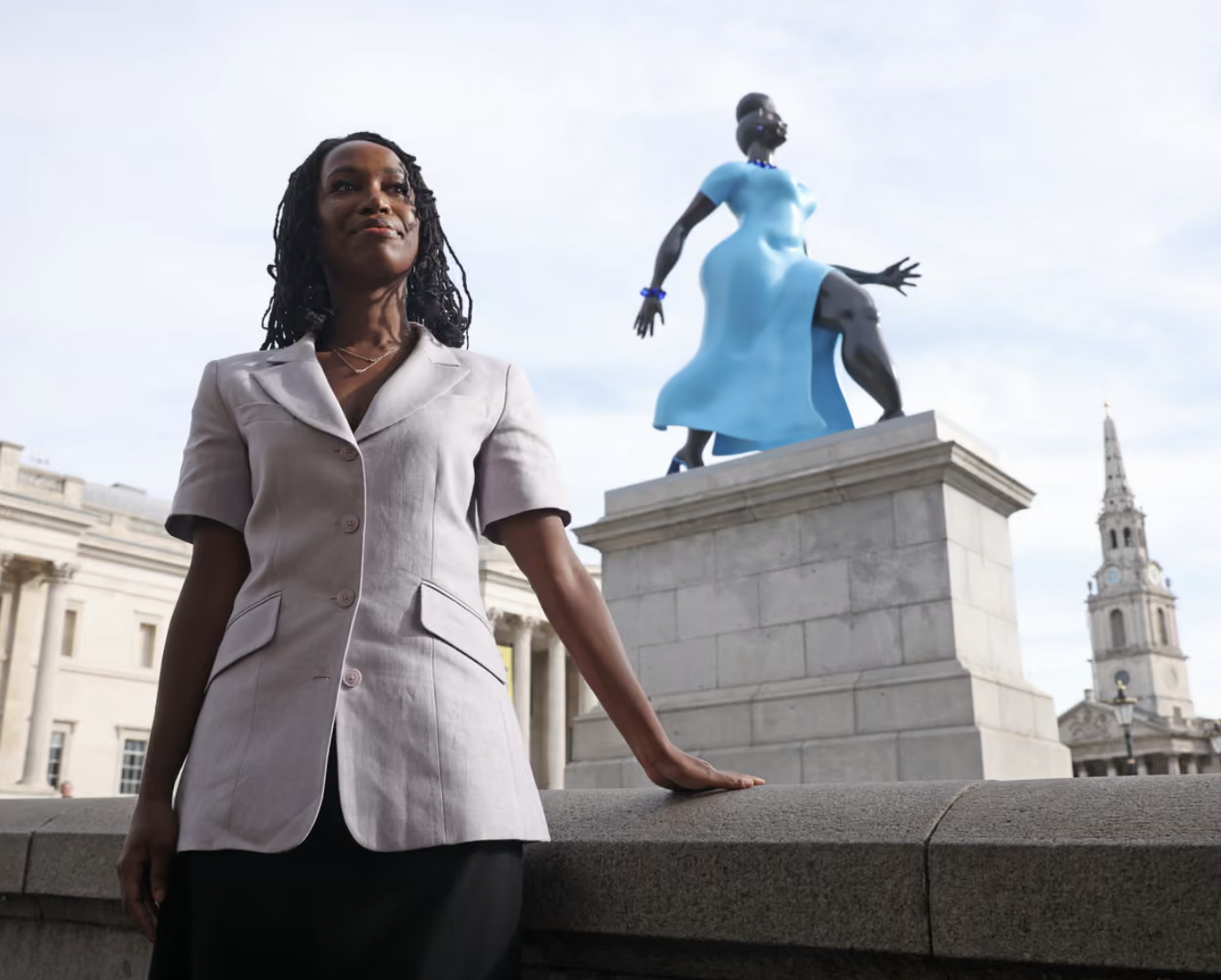
It sounds simple. In practice, it unsettles one of the conventions that monuments have relied upon for centuries. Public statues tend to explain why their subjects deserve the pedestal. Rank, conquest, political office, wealth, or national importance provide the justification. Lady in Blue refuses that transaction, and occupies a plinth because an ordinary life can be worthy of scale, visibility, and prominence too.
Self has been clear that the figure's identity should not become the limit of the work. She is a Black woman because Self's figures emerge out of her own experience, but the artist has resisted the assumption that Black subjects must always function primarily as representations of Blackness. Her ambitions for the sculpture are broader. She wants a Black woman to be capable of representing personhood itself.
That distinction gives Lady in Blue much of its impact. Western art has repeatedly allowed certain bodies to operate as natural stand-ins for humanity, while others are read through race, gender, or difference before anything else. Self places a visibly Black female figure in one of London's most conspicuous public spaces and makes no attempt to translate her into something supposedly more universal. The challenge lies with the viewer who cannot see the particular and the universal at the same time.
Self's treatment of body reinforces confidence. The exaggerated proportions familiar across her paintings and sculptures remain, with long limbs, broad curves, and a physical presence that rejects anatomical restraint. Bronze gives the figure the material authority of traditional statuary, while the saturated blue dress pulls her firmly into Self's own visual world. She feels monumental without becoming solemn.
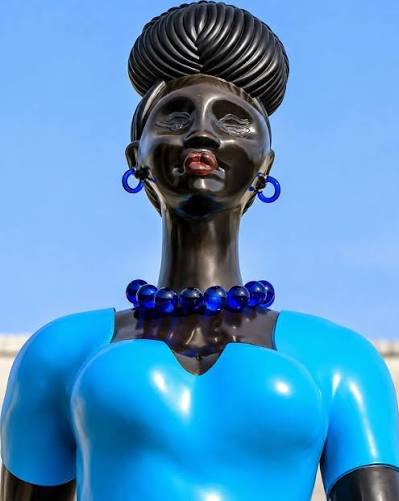
Movement is equally important. A conventional monument is designed to stay put, both physically and historically. Lady in Blue appears to be passing through. Her strides gives the peculiar impression that the enormous stone plinth can barely contain her. Trafalgar Square becomes part of her route instead of her destination.
It is tempting to frame that movement as a direct rebuttal to the history surrounding her. Self has avoided making that claim. She has said she did not want the sculpture to become reactionary to what had already happened, preferring to imagine a future in which more people can occupy social, physical, and political space freely. That position prevents Lady in Blue becoming another public artwork whose meaning depends entirely on the monuments beside it.
Still, location inevitably changes the work. An everyday woman walking at street level would disappear into the city. Raised above one of its busiest squares, the same action becomes impossible to overlook. This visibility holds greater significance to Self's history. Her earlier public sculpture Seated, another bronze Black female figure, was vandalised while displayed at the De La Warr Pavilion in 2022. White paint was sprayed specifically across the figure's skin. The incident demonstrated that simply placing certain bodies into shared spaces can still produce hostility, even when the artwork itself makes no aggressive political gestures.
Lady in Blue arrives with that knowledge behind it, but it does not appear defensive. There is humour in its scale and pleasure in its colour. The figure does not brace herself against an audience, explain herself to one or wait for its approval. She keeps walking.
That may be the sculpture's sharpest idea. Self has created a public monument without giving its subject the usual burden of providing why she deserves to be there. Lady in Blue has no victory to commemorate and no authority to advertise. Her claim to the plinth is personhood itself. For a site built around people history has already decided were important, that is a considerable change.