Table of Contents
In the years surrounding independence across West Africa, architecture became closely tied to the question of what a newly sovereign country should look like.
Governments commissioned universities, trade centres, civic buildings, housing, and infrastructure on a scale that could make political change visible. Modernism, with its association with progress and an international future, became part of that effort. At MoMA, Architects of Liberation: Modernism in Western Africa brings this period together in the first major museum exhibition dedicated to architecture and political independence in the region.
The exhibition covers the late 1950s through the early 1980s, beginning with a period of extraordinary political change. Ghana gained independence from Britain in 1957 under Kwame Nkrumah, followed three years later by the "Year of Africa", when 17 countries across the continent became independent. New governments inherited borders, cities, and institutions built under colonial rule while attempting to establish identities distinct from the power that had governed them.
Architecture offered one way to make those ambitions concrete. Across Benin, Cameroon, Côte d'Ivoire, Ghana, Nigeria, Senegal, and Togo, modern buildings appeared as expressions of national confidence, Pan-Africanism, and Africanisation. Their scale was significant. Universities trained the citizens expected to build new economies, government buildings represented new political authority, and trade fairs presented young nations to international audiences.
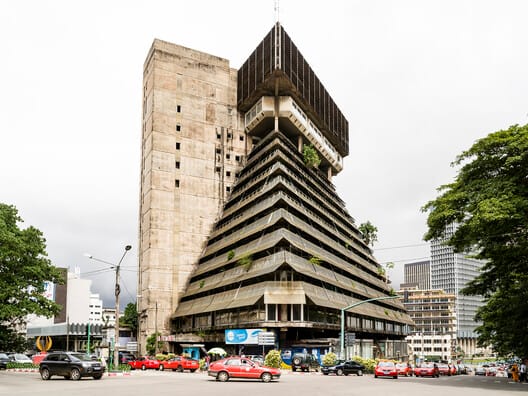
Ghana's Africa Pavilion at the Accra Trade Fair, developed between 1962 and 1967, is one example. Designed by Vic Adegbite, Jacek Chyrosz, and Stanislaw Rymaszewski, and led by the Ghana National Construction Cooperation, its circular form was conceived as a symbol of national unity. In Abidjan, Rinaldo Olivieri's La Pyramide, completed in 1973, brought offices, shops, and other uses together inside a vast concrete structure that transformed the city's skyline. Senegal's International Center for Foreign Trade, or CICES, turned the international trade fair into another opportunity to articulate a national architectural identity.
These building also complicate any idea that independence produced a clean architectural break with the colonial period. African architects including Adegbite, John Owusu Addo, Demas Nwoko, and Cheikh Ngom were establishing practices and contributing to a new architectural culture, while architects from France, Italy, Poland, Yugoslavia, and elsewhere continued to work throughout the region. Modernism itself had developed through international networks that were deeply connected to Europe.
The architecture that followed independence grew out of these overlapping conditions. Existing modernist forms were adapted for tropical climates, local materials, cultural references, and the priorities of new governments. In Senegal, President Léopald Sédar Senghor promoted ideas about national culture that influenced architecture and the arts. Elsewhere, buildings responded to different political ambitions and economic circumstances. There was no single West African version of modernism, despite the shared optimism that accompanied much of its construction.
That breadth is central to MoMA's exhibition. Around 450 drawings, photographs, publications, models, and other objects have been assembled after four years of research, with material sourced through more than 50 lenders in 17 countries. Most of the objects have never previously been publicly exhibited, and MoMA says many of the architects represented have never appeared in an exhibition or scholarly publication. The archive therefore becomes part of the exhibition's significance. It places names, buildings, and architectural records into a history of modernism that has frequently been written elsewhere.
Newly commissioned models reconstruct several major projects in remarkable detail, but the surviving buildings tell another part of the history. More than half a century has passed since many were completed. Some have been altered, neglected, or stripped of features that once defined them. The immaculate models preserves the confidence of the original designs, contemporary photographs record what decades of political, economic, and urban change have done to them.
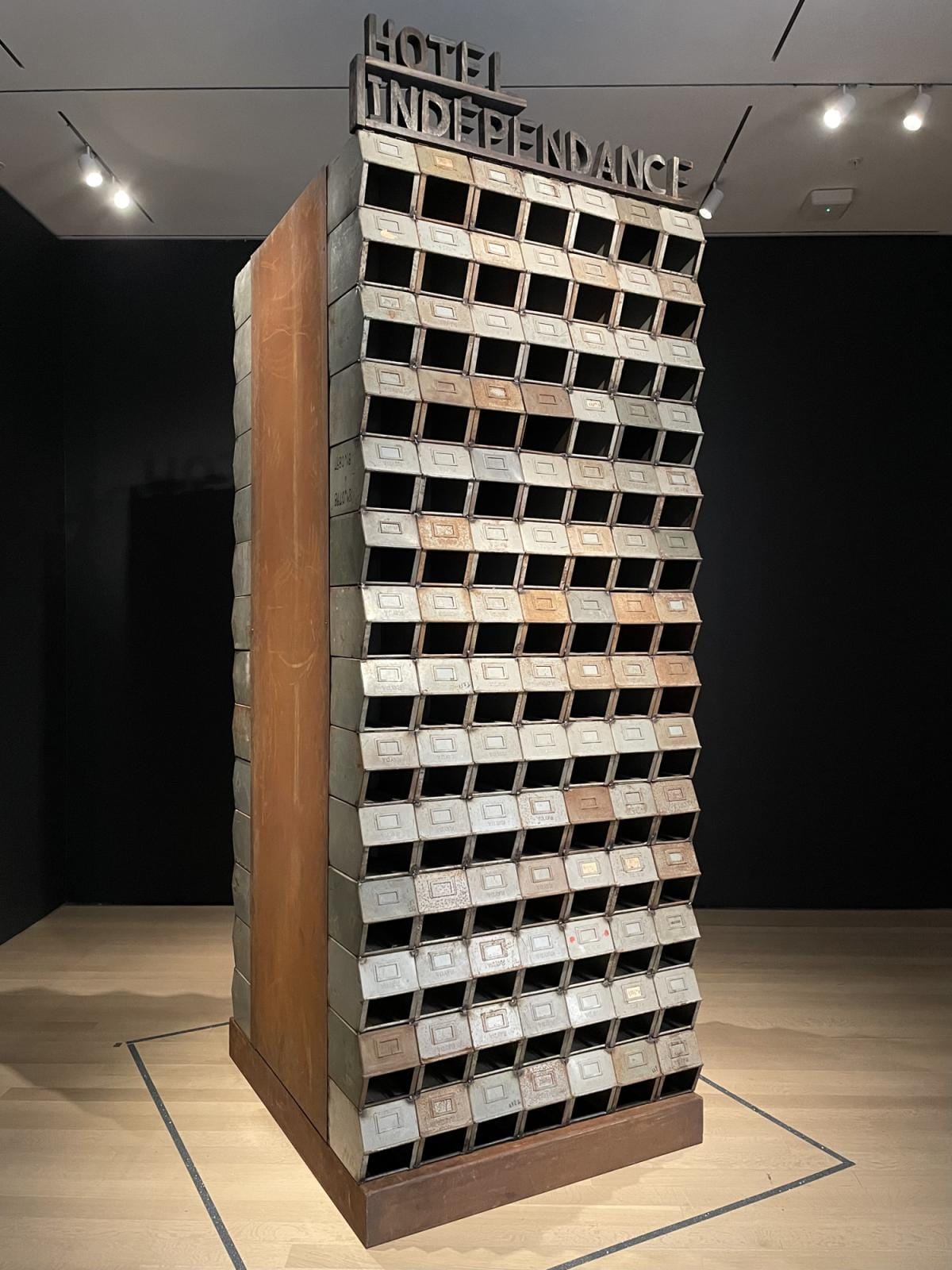
Near the end of the exhibition, Kader Attia's Indépendance Tchao (Goodbye, Independence), made in 2014, offers a particularly pointed response to that history. His model of Dakar's Hôtel de l'Indépendence is constructed using metal archive boxes from the French colonial administration. The material is difficult to separate from the building it recreates. Independence produced new institutions and new architecture, but colonial systems did not disappear at the moment sovereignty was declared.
That tension makes the period so important. The architecture gathered at MoMA records governments and architects working through the possibilities of independence while confronting the structures left behind by colonial rule. Many of their buildings remain in West African cities today, carrying the ambitions of the moment in which they were built and the history that followed.
Architects of Liberation: Modernism in Western Africa is on view at the Museum of Modern Art, New York, until January 2, 2027.